InboxArmy Pricing & Packages: What to Expect (2026)
Quick answer: InboxArmy pricing is custom / on request — they don’t publish a standard rate card, because cost depends on scope, ESP, send volume and whether you want production or full-service management. Expect a quote shaped by your specific engagement rather than a fixed package price. Below we explain what drives InboxArmy pricing, what’s typically included, and the alternatives at each budget band — with the only publicly sourced market numbers (Chronos ~$10k/mo, Mayple from ~$1,280/mo) for reference.
Key takeaways
- InboxArmy pricing is custom / on request — no public standard rate card.
- Cost is driven by scope, ESP, send volume and production vs full-service management.
- Expect a quote, not a fixed package price — confirm what’s included before signing.
- For market reference, only Chronos (~$10k/mo) and Mayple (from ~$1,280/mo) publish hard numbers.
- Judge any agency on revenue generated, targeting roughly 3x ROI.
If you’re pricing out InboxArmy and want to know what to expect, here’s an honest, sourced guide — without invented figures. We won’t put a fake number on their packages, because they don’t publish one; instead we’ll explain what shapes the quote you’ll receive, what a thorough engagement should include, and how to benchmark the proposal against the rest of the market so you can judge value rather than guess at a price.
InboxArmy pricing at a glance
InboxArmy pricing is custom / on request: they quote per engagement rather than publishing fixed package prices. Like most full-service email agencies, the cost depends on what you actually need, so the right expectation is a tailored quote shaped by scope and volume — not a number you can read off a page. This is normal for the category rather than a red flag: an end-to-end engagement for a small store with a handful of flows is a different cost to a high-volume program spanning multiple ESPs, heavy campaign cadence and deliverability work, and a single rate card can’t honestly represent both. The practical implication is that you should treat any figure you hear second-hand as a starting point at best, and get your own quote against your own scope.
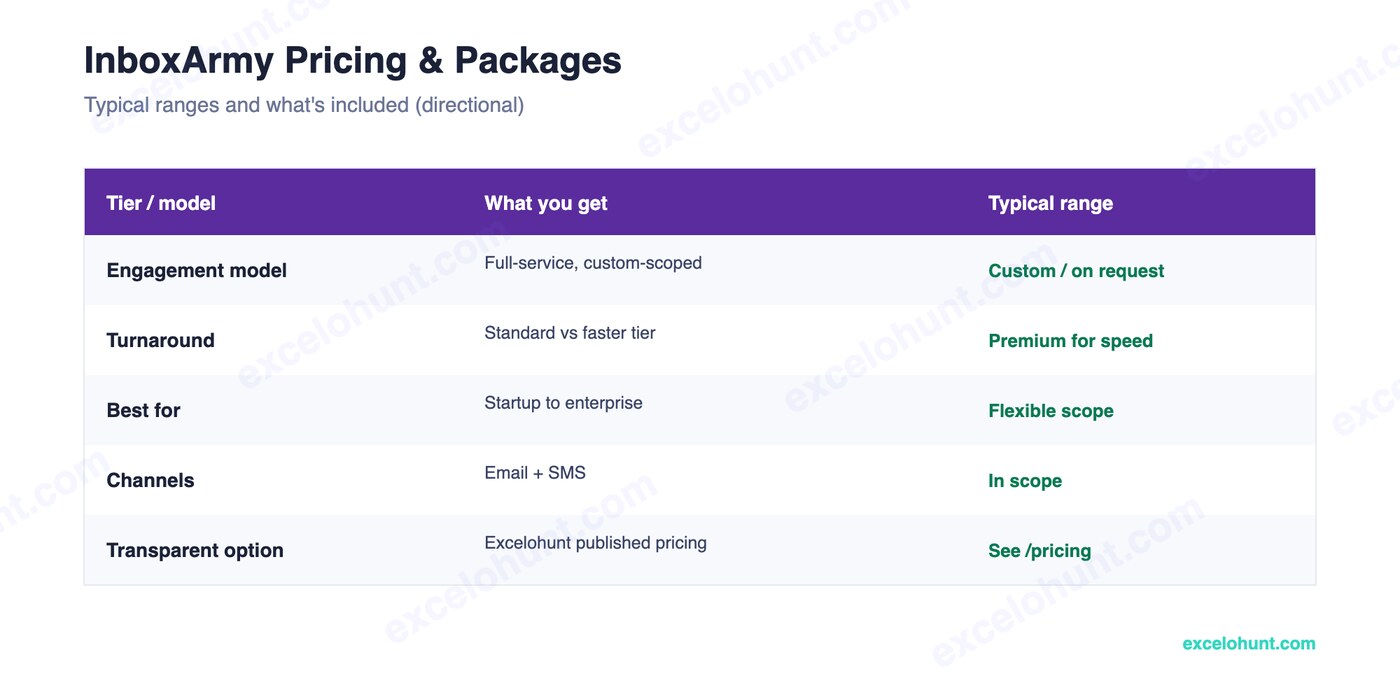
| Item | Detail (as of July 2026) |
|---|---|
| Published rate card | No — custom / on request |
| Model | Full-service, project or retainer |
| Platform focus | ESP-agnostic (many ESPs) |
| What sets the price | Scope, ESP, send volume, channel count |
| How to get a number | Request a quote for your scope |
Per inboxarmy.com and their Clutch profile, pricing is not published as a standard rate. Confirm current terms directly with the agency.
What’s included
An InboxArmy engagement typically covers full-service email — campaign management, automation, template production, ESP migrations and deliverability — across major platforms. Per their site, they position as an end-to-end email partner rather than a single-platform specialist, so the scope you buy can range from focused production to broader ongoing management.
Because the package isn’t fixed, the most important step is to confirm exactly what’s in your scope before signing. From our experience evaluating agencies, ask specifically:
- Is this production only (building emails) or full lifecycle (strategy, flows, campaigns, reporting)?
- Does it include SMS, or email only?
- Which ESP is in scope, and who owns the account?
- How is reporting delivered — revenue attribution, or just opens and clicks?
Our how to choose an email marketing agency guide has the full vetting checklist for these questions.
The reason these questions matter for pricing specifically is that scope and price move together. Two quotes that look different on paper may simply reflect different scopes — one might bundle SMS and deliverability while the other is email production only. Until you’ve pinned down exactly what’s included, you can’t tell whether a higher number is genuinely more expensive or just more complete. A useful tactic is to write a one-page brief describing your store, ESP, list size, current flows and the outcome you want, then ask every agency to quote against that identical brief. That turns vague “custom” numbers into directly comparable proposals.
How they structure engagements
Full-service agencies like InboxArmy generally structure work as either a fixed-scope project or an ongoing retainer. A project suits a defined deliverable — a flow build, a migration, a template library — while a retainer suits continuous management of campaigns and automations.
The structure matters as much as the price. A project gives you a clear, one-time cost but no ongoing ownership of results; a retainer gives you continuous management but should be judged on the revenue it produces each month. A common and sensible pattern is to start with a project — say, a flow build or an ESP migration — to see the quality of work, then move to a retainer for ongoing campaigns and optimization once you’ve validated fit. If you go this route, clarify up front how the project price relates to the retainer, and whether the strategy and assets built in the project carry over so you’re not paying twice. Whichever you’re quoted, tie the cost to outcomes rather than to deliverable counts alone. The mechanics of retainer vs project vs performance pricing are covered in our email marketing agency pricing explained breakdown.
Value vs price
The real measure of InboxArmy’s pricing isn’t the headline quote — it’s the revenue the engagement generates relative to its cost. A custom quote is only “expensive” or “cheap” once you know what’s included and what it returns.
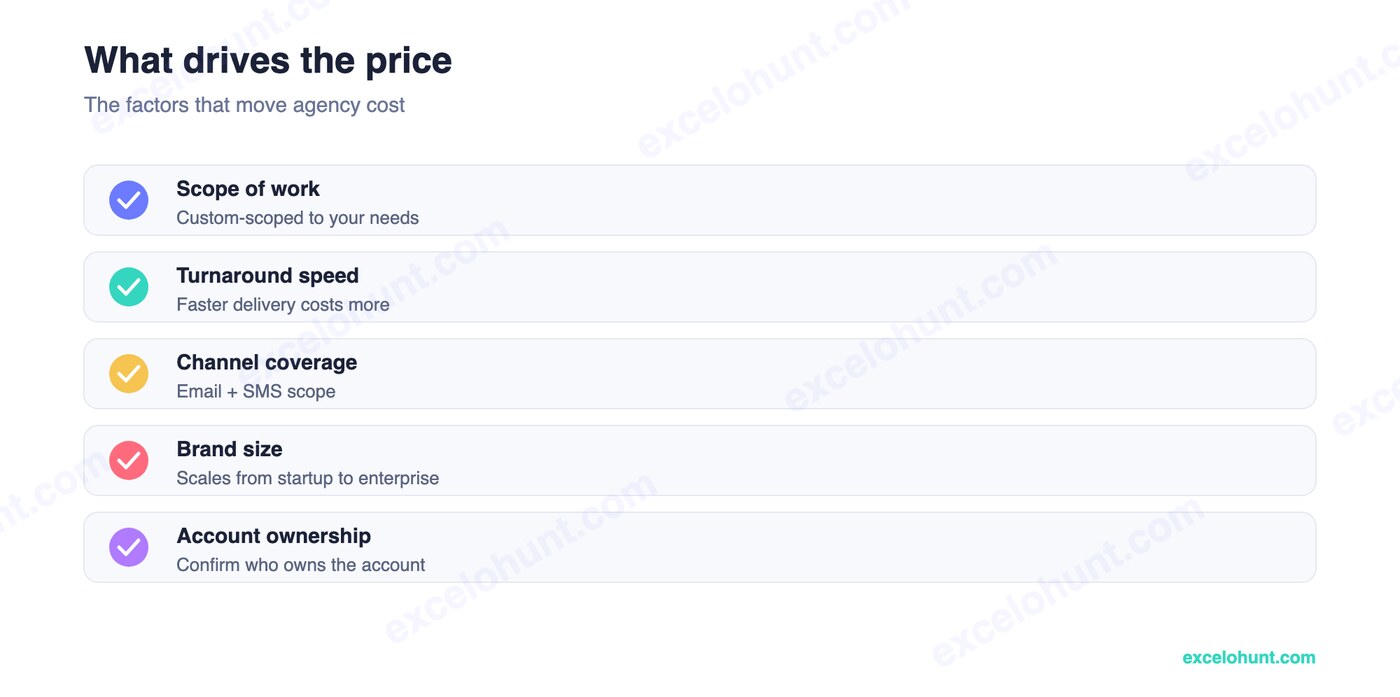
When you compare the quote, weigh three things: scope (production vs full lifecycle), channels (email vs email + SMS), and platform depth (ESP-agnostic vs a dedicated specialist). A broad, ESP-agnostic shop is a strength if you’re not on Klaviyo, mid-migration, or running multiple platforms; if you’re all-in on Klaviyo, a dedicated Klaviyo agency may go deeper on flows, segmentation and predictive features for similar money. Neither is universally better — it depends entirely on your stack and what you want the channel to do.
To make value concrete, run the simple math: estimate the incremental monthly revenue the engagement should add, divide by the cost, and look for a multiple of roughly 3x or better. If a $120k/mo brand has email at 12% of revenue and a strong program could lift it toward the high-20s, that’s well over $15k/mo of incremental revenue — which reframes almost any reasonable retainer as an investment rather than an expense. Either way, target a ~3x ROI and judge value on incremental revenue, not the rate.
Alternatives by budget
If you want reference points or a different model, the alternatives span premium agencies, marketplaces, mid-market specialists and freelancers. The table below is the original, plain-English picture — with only the publicly sourced numbers attributed and everything else marked custom / on request.
| Budget band | Option | Reference price |
|---|---|---|
| Premium | Chronos Agency | ~$10k/mo min (per Clutch) |
| Mid-market managed | Dedicated Klaviyo agency | Custom / on request |
| Full-service | InboxArmy | Custom / on request |
| Marketplace | Mayple | From ~$1,280/mo (per their site) |
| Entry | Freelancer / boutique | Project or hourly, custom |
As of July 2026. Only Chronos (~$10k/mo, per Clutch) and Mayple (from ~$1,280/mo, per their site) publish or report hard numbers; InboxArmy and most others quote custom / on request.
For $40k+/mo DTC brands specifically, a transparent mid-market Klaviyo agency often gives the best balance of cost and depth — which is where we sit, with published pricing, a named expert in Ravinderpal Singh, and a 3x ROI focus across 500+ brands. If you’re on Klaviyo, our Klaviyo pricing guide also helps you separate platform costs from agency fees so you can read a proposal accurately. The fastest way to compare your options on a like-for-like basis is to get a free Klaviyo audit and a clear quote, then weigh it against an InboxArmy proposal. Our case studies and our pricing show our side transparently.
Frequently asked questions
How much does InboxArmy cost?
InboxArmy pricing is custom / on request — they don’t publish a standard rate card, so cost depends on your scope, ESP, send volume and whether you want production or full-service management. The best way to get a number is to request a quote for your specific engagement.
Does InboxArmy publish pricing?
No. Per their site and Clutch profile, InboxArmy does not publish a standard rate card as of July 2026. Like most full-service email agencies, they quote per engagement, so you’ll need to request a proposal rather than read a fixed price.
What’s included in their packages?
Engagements typically cover full-service email — campaign management, automation, template production, ESP migrations and deliverability — across major platforms. Because scope varies, confirm whether your quote is production-only or full lifecycle, whether SMS is included, and who owns the account.
What are alternatives at different price points?
For reference, Chronos sits at the premium end (~$10k/mo min, per Clutch) and Mayple at the marketplace end (from ~$1,280/mo, per their site). In between are mid-market managed Klaviyo agencies (custom / on request) and freelancers for early brands. Match the option to your revenue and the model you need.
About the author
Ravinder is the founder of Excelohunt, a Klaviyo-focused email & SMS agency that helps ecommerce brands grow revenue from email and SMS.
Want a transparent quote to compare against InboxArmy? Reviewed by Ravinderpal Singh. Get a free Klaviyo audit or see how we run email for brands.
All trademarks are the property of their respective owners. Excelohunt is not affiliated with or endorsed by the companies named on this page. Comparisons reflect publicly available information as of July 2026.
More in Strategy
- Best Email Marketing Agencies for Small DTC Brands ($40k+/mo)
- Best Email & SMS Marketing Agencies for Ecommerce (2026)
- Chronos Agency Alternatives for $40k–$500k/mo DTC Brands
- Chronos Agency Pricing Explained: Is the $10k Minimum Worth It?
- Chronos Agency vs InboxArmy: Which Is Better for DTC Email?
Want Us to Implement This for Your Brand?
Get a free email audit and see exactly where you're losing revenue.
Get Your Free Audit