Case study
 with
with 
A festive gifting brand whose whole year is decided between July and November, and a list that could not carry it until the foundations were rebuilt.
Nidhi needed the festival season to arrive in inboxes that could actually receive it.
Nidhi Ruperee is President of LoveNspire, a festive gifting brand in Stevensville, Michigan that she runs with Prashant, its co-owner. Its year is decided between July and November, and in May 2025 the audit found a list that could not carry that season: roughly 70% suppressed with no documented reason, DMARC not enabled, and flows firing at the wrong people. June went on foundations so that July's festivals would land. In the first full month with every flow live, attributed email revenue was 3.8 times the June baseline.
- The problem
- A mostly suppressed list, an unauthenticated domain, and flows working against her own customers.
- The plan
- Foundation, then flows, then festivals. In that order or not at all.
- The result
- Attributed email revenue 3.8 times the June baseline in July, and a 70% open rate in August.
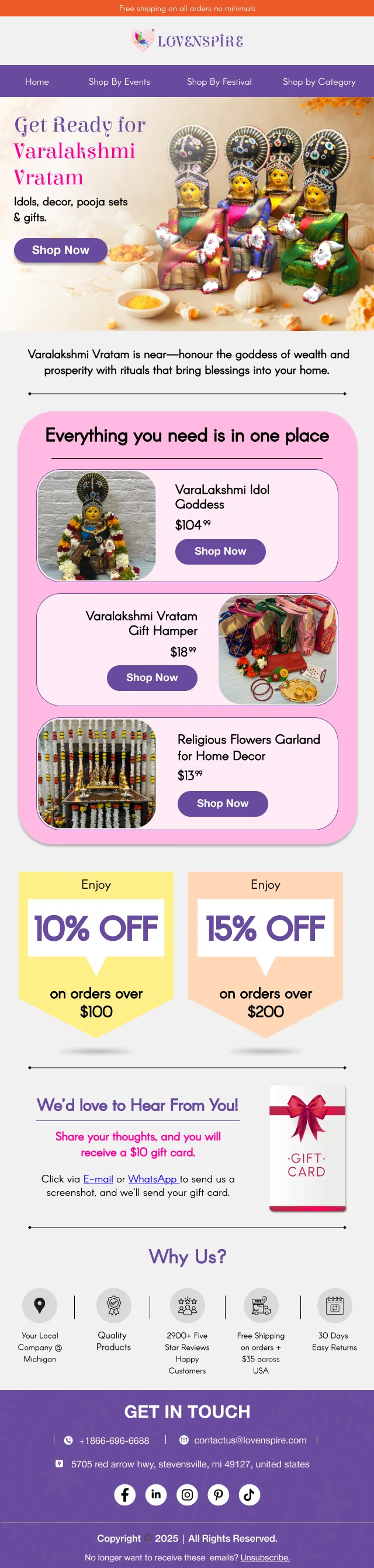
Get Ready for Varalakshmi Vratam · Festival campaign · July 2025 · 1 of 4
Real festival and campaign designs from the LoveNspire account
-
Step 1 · May 2025
Audit
The first conversation with Prashant was an audit, not a pitch: what was suppressed and why, what the DMARC record was doing, where each flow was firing at the wrong person.
- 70% of list suppressed
- No DMARC
- Browse flow with no order filter
- No purchase exits
- Two email cart flow
- Dear Friend welcome
-
Step 2 · June 2025 onward, three phases
Strategy
June for foundations, so July's festivals would land. The order is the point.
- Authenticate and clean
- Rebuild the flows so they respect the customer
- Build the festival calendar around what actually sells
-
Step 3 · July and August 2025
Results in the first season
3.8×Attributed email revenue in July 2025, as a multiple of JuneFrom 1.0× in June, the month the flows went live70%Campaign open rate, August 2025From 50.6% and falling at the audit, 76.6% on the top festival send94.6%Of email revenue from flows, August 2025Flows mis-firing at the audit, 87% in July0.26%Unsubscribe rate, July 2025, against a healthy band of under 0.3%Not reported at the audit, inside the healthy band while campaign frequency doubled
The problem
A big list, a full calendar, and flows that were working against her own customers.
LoveNspire's year is decided between July and November: Varalakshmi, Raksha Bandhan, Janmashtami, Ganesh Chaturthi, Onam, Navratri, Karwa Chauth, Diwali. The list existed to carry that season. It could not.
Roughly 70% of the list was suppressed, with no documented reason why. DMARC was not enabled on the sending domain. Browse abandonment had no order filter, so customers who bought the product they browsed still got "we noticed you visited". Nobody exited a flow on purchase. The cart flow was two emails. The welcome email opened with "Dear Friend" and had the word WELCOME laid over people's faces.
Nidhi could not trust the list she was paying to mail. She did not know whether suppressed profiles were legitimately excluded multi-channel customers or lost prospects, whether a re-engagement send would help or hurt, or why emails that opened well were converting at three orders per ten thousand. With the festivals weeks away, the one channel that should have been dependable was the one she could not read.
A brand built around the emotional weight of festivals should not have to greet a customer as "Dear Friend". Families buying a Ganesha for the first pooja in a new home deserve to be spoken to like the brand knows who they are. Personal relevance and clean infrastructure should not be a trade-off. One is impossible without the other.
The villain is list decay.
A list rots quietly from two directions at once: bot signups and multi-channel buyers inflate it while unengaged and mis-mailed contacts drag its reputation down. Nobody decides to let it happen. It is the default outcome of a busy brand with a seasonal calendar and a platform that keeps sending regardless. By the time it shows up as a number, it has already cost a season.
The guide
We recognised the shape before we had finished the audit.
Multi-channel brands that sell on Amazon, Walmart and marketplaces as well as their own store nearly always arrive with a list that is mostly suppressed and a team that is nervous about touching it. The suppression is often correct in principle and undocumented in practice, which makes it useless. Add a seasonal calendar and the pattern completes itself: flows set up once and never revisited, because every spare hour goes to the next festival.
So the first conversation with Prashant in May 2025 was an audit, not a pitch: what was suppressed and why, what the DMARC record was doing, where each flow was firing at the wrong person. From that came a plan with a deliberate shape. June for foundations, so July's festivals would land.
The plan
Foundation, then flows, then festivals. In that order or not at all.
This is the plan we gave Nidhi and Prashant. The order is the point.
Authenticate and clean
Enable DMARC. Document the suppression logic so the list has rules instead of a history. Filter unengaged profiles out of sends. Put ReCAPTCHA on the signup form so bot addresses stop entering the list at the source.
Why first: every later phase is measured by inbox placement. An unauthenticated domain with a dirty list makes flow and campaign results unreadable, because you cannot tell a bad email from an email nobody received.
Rebuild the flows so they respect the customer
A five-email welcome series with a real name in the greeting. Abandoned cart with its own checkout code. Browse abandonment with an order filter and a purchase exit. Post-purchase, winback, VIP and first-purchase anniversary added.
Why second: the festival calendar is about to send a surge of visitors to the site. Flows are what convert that surge after the campaign is forgotten. Run the festivals first and the surge leaks out through flows that still email people who already bought.
Build the festival calendar around what actually sells
Four campaigns a month, each anchored to a festival and the products that move for it: idols, pooja essentials, décor and gifting for married women at Varalakshmi; kids' rakhis, name rakhis, lumba hampers and personalised chain rakhis for Raksha Bandhan, with the US demand for name rakhis and hampers front and centre. A tiered offer instead of a flat discount.
Why last: campaigns are where the brand's voice finally shows. They deserve to land on a list that can hear them and flows that can catch what they stir up. Done first, they would have been the best-designed emails ever sent to a spam folder.
What Nidhi did
She gave us the keys and then let June be quiet.
- Gave access. The email platform, the store, and the domain records needed to enable DMARC.
- Approved the flows against dates, not feelings. Every welcome email design reviewed and signed off; browse abandonment and cart flows live by 26 June 2025; the welcome flow held back until its technical issue was resolved rather than pushed live half-working.
- Generated the codes. A dedicated checkout code for the cart flow and, when generic codes started being shared, agreed to move high-value flows to unique codes.
- Supplied what sells. Best-selling products by festival, purchase trends, and curated new-launch and bestseller pages, so campaigns were built on her knowledge of the customer rather than our guess.
- Moved the working relationship to where she actually was. WhatsApp for day-to-day, a weekly call, phone for urgent matters, with brief stand-ups added when approvals needed to move faster.
- Held her nerve through June. The month before the season went almost entirely on infrastructure, with the active list shrinking as it was cleaned and very little visible campaign activity. That is a hard month to sit through when Varalakshmi is next.
The stakes
What this avoided, and what it became.
Failure avoided
- A festival season sent from an unauthenticated domain, with the brand's biggest weeks at the mercy of spam filtering.
- Customers who had just bought a Ganesha receiving "we noticed you were looking at" emails about the Ganesha, during the week they were setting it up.
- Continuing to convert three orders per ten thousand recipients while open rates slowly slid, with no way to tell why.
- A list that kept inflating with bot signups and marketplace buyers until platform costs rose and reputation fell together.
Success it became
- Attributed email revenue 3.8 times the June baseline in July, the first full month with every flow live.
- A 70% monthly open rate in August, with the top festival send opening at 76.6%.
- Between 87% and 95% of email revenue coming from automation, so the account earned through the season without depending on any single campaign.
- Spam complaints at 0.02 to 0.03% and unsubscribes at 0.26% while campaign frequency doubled.
The transformation
Nidhi can now plan a festival knowing the list will carry it.
The change for her is confidence in the channel rather than hope. Before, the list was a liability she could not read. Now the monthly report tells her which flow made the money, which festival send opened best, and what the list is doing to its own reputation. She can add a campaign to the calendar and expect it to land. She can ask for more frequency, which she did, and get it without the numbers falling over.
August is worth reading honestly. Revenue eased from 3.8 times the baseline to 2.6 times while engagement climbed by more than 16 points, and flows carried 95% of the month's email revenue. Two campaigns opened above 76% and one of them produced very little. The lesson the report drew was not "send less" but "opens are solved, clicks are next": the festival subject lines and segmentation were working, and the click rate on campaigns was still well under the category benchmark. That is where the next phase of the plan points.
What Nidhi can say with the report open: the flows she approved in June made most of the money in July and August, the domain is authenticated, the list is cleaner and smaller and worth more, and the season landed.
Attributed email revenue index and campaign open rate
Revenue shown as a multiple of June 2025. Absolute revenue withheld. Open rate is the monthly average. Figures from the July and August 2025 monthly performance reports.
Evidence
Before, achieved, benchmark
Every line we could source a published benchmark for. Lines below benchmark are left in. A page with no weak lines reads as unverified.
| Metric | Before | Achieved | Benchmark | Verdict |
|---|---|---|---|---|
| Campaign open rate | 50.6%, down 10 pts | 54.5% (Jul) · 70.0% (Aug) | 32.5% home & garden | Above |
| Campaign click rate | 0.32% | 0.32% to 0.80% (top and bottom campaigns, Jul and Aug) | 1.78% home & garden | Below |
| Campaign placed order rate | 0.03% | Not reported post-rebuild | 0.13% home & garden | Unmeasured |
| Deliverability score | Not recorded | 65 (Jul) | 75 to 89 = Good | Fair, below Good |
| Email authentication | DMARC not enabled | Enabled | Required by Gmail and Yahoo for bulk senders | Meets |
| Spam complaint rate | Not reported | 0.03% (Jul) · 0.02% (Aug) | Under 0.01% healthy; 0.01 to 0.05% needs improvement | Needs improvement band |
| Bounce rate | Not reported | 0.45% (Jul) · 0.66% (Aug) | Under 1% healthy | Above |
| Unsubscribe rate | Not reported | 0.26% (Jul) | Under 0.3% healthy | Above |
| Flow share of email revenue | Flows mis-firing | 87% (Jul) · 94.6% (Aug) | ~41% | Above |
| Share of list suppressed | ~70% | Documented and filtered; new figure not on file | Not compared | Unmeasured |
Before figures from the May 2025 audit. Achieved figures from the July and August 2025 monthly performance reports. Benchmarks: Klaviyo 2026 email benchmarks (Home & Garden used as the nearest published vertical for festive décor and gifting; all-industry where noted), Klaviyo deliverability guidance and deliverability hub bands.
Results by programme
| Initiative | Outcome | Figure |
|---|---|---|
| Account audit (May 2025) | Suppression, authentication, content, engagement and nine flow-logic faults documented with examples; became the plan Prashant and Nidhi approved. | n/a |
| Authentication and list hygiene | DMARC enabled, suppression logic documented, unengaged profiles filtered, ReCAPTCHA stopped bot signups. Bounce and unsubscribe rates held inside healthy bands while frequency doubled. | 0.45% bounce · 0.26% unsub |
| Welcome flow (5 emails) | Rebuilt with a real greeting, spacing, and a call to action beside the offer; held until its technical issue was fixed, then live. | n/a |
| Browse abandonment and abandoned cart | Order filter and purchase exit added; cart flow given a dedicated checkout code. Both live by 26 June 2025. | n/a |
| Post-purchase, winback, VIP, first-purchase anniversary | Built and tested August 2025; unique codes for high-value flows agreed. | n/a |
| All flows together | Automation became the dominant revenue source for the season. | 87% → 94.6% of email revenue |
| Festival campaign calendar | Four campaigns a month built around festival best-sellers and a tiered offer. Varalakshmi and Raksha Bandhan was the top July send; Ganesh Chaturthi and Onam the top August send. | 66.5% and 76.6% opens |
| Reporting rhythm | Monthly KPI report with benchmark, top and underperforming campaigns and SWOT; weekly sync; WhatsApp for daily work. | n/a |
In the client's words
"Thank you so much, girls. I really appreciate all the support you are doing. You are doing amazing."
Nidhi Ruperee, President, LoveNspire. Weekly call, 17 July 2025, from the recording transcript.
Nidhi pushed for stronger aesthetics and tighter product curation in the campaign designs, and for a checking process that made every send error-free, because for a brand built on festivals, credibility is the product.
Nidhi Ruperee, President, LoveNspire. Paraphrased from the weekly call summary, 21 August 2025.
Your turn
Nidhi's plan is the same plan we would give you.
-
Authenticate and clean
We audit the list, the domain and every flow. You give us the keys and let one quiet month happen.
-
Rebuild the flows so they respect the customer
We make every automation know who has already bought. You approve them against a date.
-
Build the calendar around what sells
Your season goes out to a list that can carry it, and the flows catch what it stirs up.
If your biggest weeks of the year are coming and you are not sure the list can hold them, the audit is where it starts.
If your biggest weeks of the year are coming, start with the audit
We audit the list, the domain and every flow, rebuild the automations so they know who has already bought, then build the calendar around what sells, in the same order we did it for LoveNspire.