How to Choose an Email Marketing Agency (10-Point Checklist)
Quick answer: To choose an email marketing agency, work a 10-point checklist: define your goals, then vet the agency on relevant ICP fit, platform expertise (e.g. Klaviyo), transparent pricing, clear scope, real case studies, account and data ownership, reporting that ties to revenue, communication cadence, and contract flexibility. The best fit is the one whose specialism, brand-size focus, and reporting match your stage — not the cheapest or the biggest name.
Key takeaways
- Define goals first — revenue targets, channels, and brand stage decide which agency fits.
- Match the ICP — an agency built for $40k+/mo DTC brands is the wrong fit for an enterprise, and vice versa.
- Platform depth matters — confirm real Klaviyo (or your platform) expertise, not a logo.
- Demand ownership — you should own your Klaviyo account, list, and data, always.
- Judge reporting on revenue, not opens — vanity metrics are a red flag.
Choosing the wrong email partner costs you months and momentum. This 10-point checklist is the exact framework that Excelohunt founder Ravinderpal Singh and our team would use to vet an agency if we were the ones hiring.
Define your goals first
Before you talk to any agency, write down what “success” looks like — a revenue target, the channels you want (email, SMS, or both), and your current monthly store revenue. This single step filters out most mismatches, because the right agency for a $50k/mo brand launching SMS is different from one for a $500k/mo brand optimising deliverability. Knowing your stage lets you screen for relevant ICP fit instead of being dazzled by a big logo. If you’re still weighing whether to hire out at all, our DIY vs agency cost comparison is a useful gut-check.
Concretely, before any call write down four things: your current monthly store revenue, the share of it email and SMS drive today, the one number you most want to move in the next six months, and your realistic monthly budget. Those four answers do most of the screening for you. A brand at $40k/mo wanting to launch its first proper flow suite has very different needs from a brand at $400k/mo trying to lift deliverability and squeeze more from SMS — and an agency that’s great for one is often wrong for the other. Clarity on your own goals also makes you a better client: agencies do their best work when the brief is specific, so the time you spend defining success pays back through the whole engagement.
The 10-point checklist
Use this 10-point checklist to score every agency you shortlist — each item is a yes/no you can verify before signing. Treat any “no” as a question to dig into, not necessarily a deal-breaker, but a pattern of “no”s means walk away.
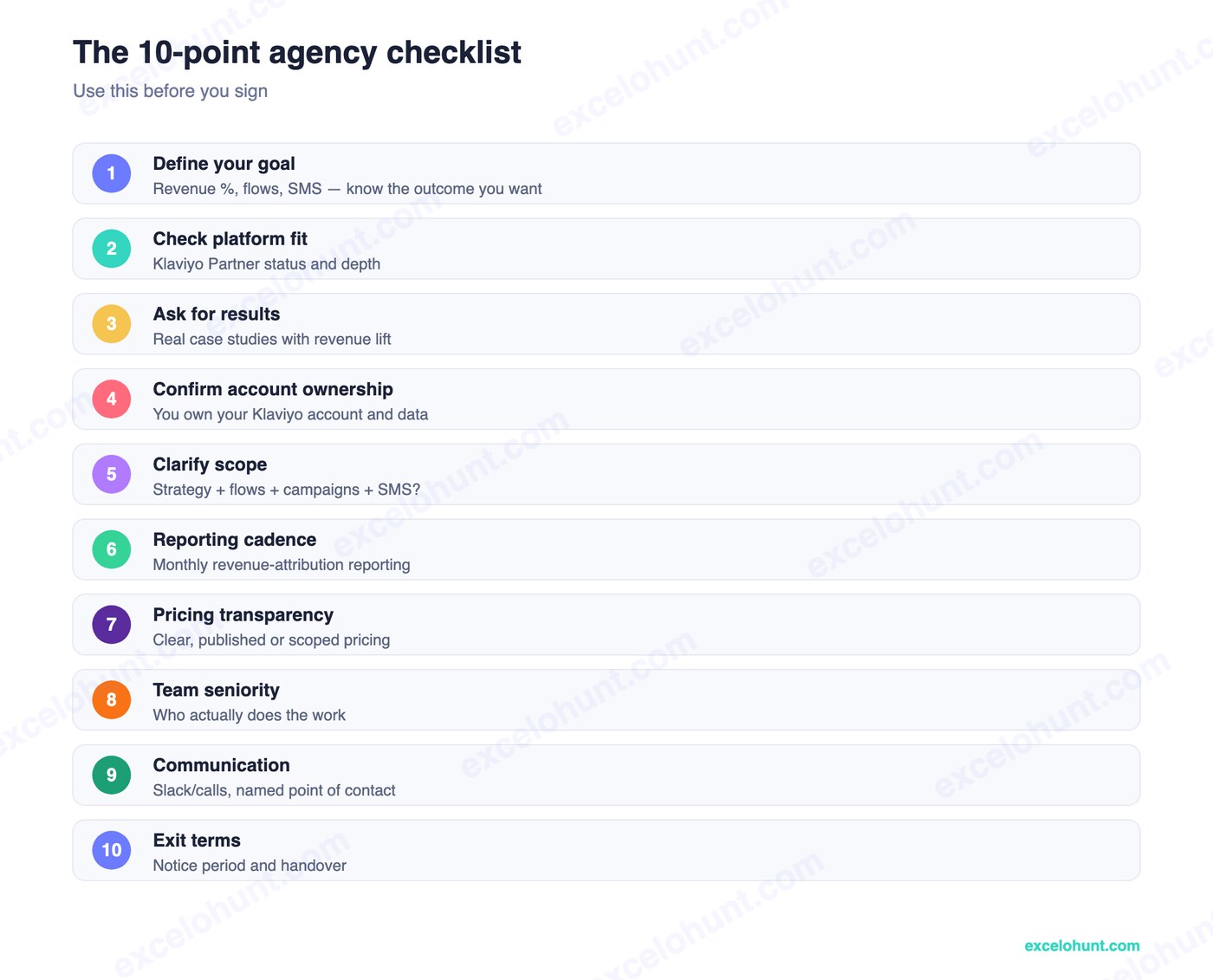
| # | Checklist item | What “good” looks like |
|---|---|---|
| 1 | ICP fit | They specialise in your brand size (e.g. $40k+/mo DTC) and vertical |
| 2 | Platform expertise | Verified Klaviyo Partner or equivalent, not just “we use it” |
| 3 | Transparent pricing | Published or clearly explained retainer, no vague “it depends” |
| 4 | Defined scope | Exact deliverables, cadence, and SLAs in writing |
| 5 | Real case studies | Named results for brands like yours, not stock claims |
| 6 | Account & data ownership | You own the Klaviyo account, list, and all data |
| 7 | Revenue-tied reporting | They report attributed revenue, not just open rates |
| 8 | Strategy, not just production | A named strategist owns your roadmap |
| 9 | Communication cadence | Clear point of contact and review rhythm |
| 10 | Contract flexibility | Reasonable term, fair exit, no lock-in traps |
Work top to bottom. A Klaviyo agency that nails items 1, 2, 6, and 7 is usually worth a deeper conversation even if one or two others need clarifying.
1–3: Fit, platform, and price
Start with whether they actually serve brands like yours. An agency optimised for enterprise will under-serve a lean DTC brand, and a boutique shop may lack the bandwidth for a large catalogue. Confirm genuine platform depth — for Klaviyo, that means a verified Partner tier and people who’ve built advanced flows and segments, not a generalist who “also does email.” Then insist on pricing you can actually plan around; see email marketing agency pricing explained for the bands to expect.
4–7: Scope, proof, ownership, reporting
Get the scope in writing: number of campaigns, which flows, SMS or not, design volume, and review cadence. Ask for case studies with named results for comparable brands — our case studies are an example of what specific proof looks like. Non-negotiable: you own your Klaviyo account and list. And reporting must connect to revenue — attributed email and SMS revenue, not opens and clicks alone.
8–10: Strategy, communication, contract
A great agency assigns a strategist who owns your roadmap, not just a queue of production tasks. You should know exactly who your point of contact is and how often you’ll review performance. Finally, read the contract for term length and exit terms — fair agencies don’t need to trap you.
The difference between strategy and production is the one most brands underrate. A production-only shop will build whatever you ask for, competently, but won’t tell you that your welcome flow is leaking revenue or that you’re over-sending to a disengaged segment. A strategist owns the roadmap: they decide what to build next based on your data and goals, run tests, and hold themselves to a revenue number. When you’re paying agency rates, you’re paying for that judgement — so make sure a named, senior person is actually applying it to your account, not just managing a task queue. On contracts, a month-to-month or short initial term with a clean exit is the mark of an agency confident in its results; multi-year lock-ins with steep early-exit penalties are the opposite signal.
Questions to ask on the call
On the intro call, ask pointed questions that expose how the agency really works — the answers separate strategists from order-takers. Use the second graphic as your cheat-sheet:
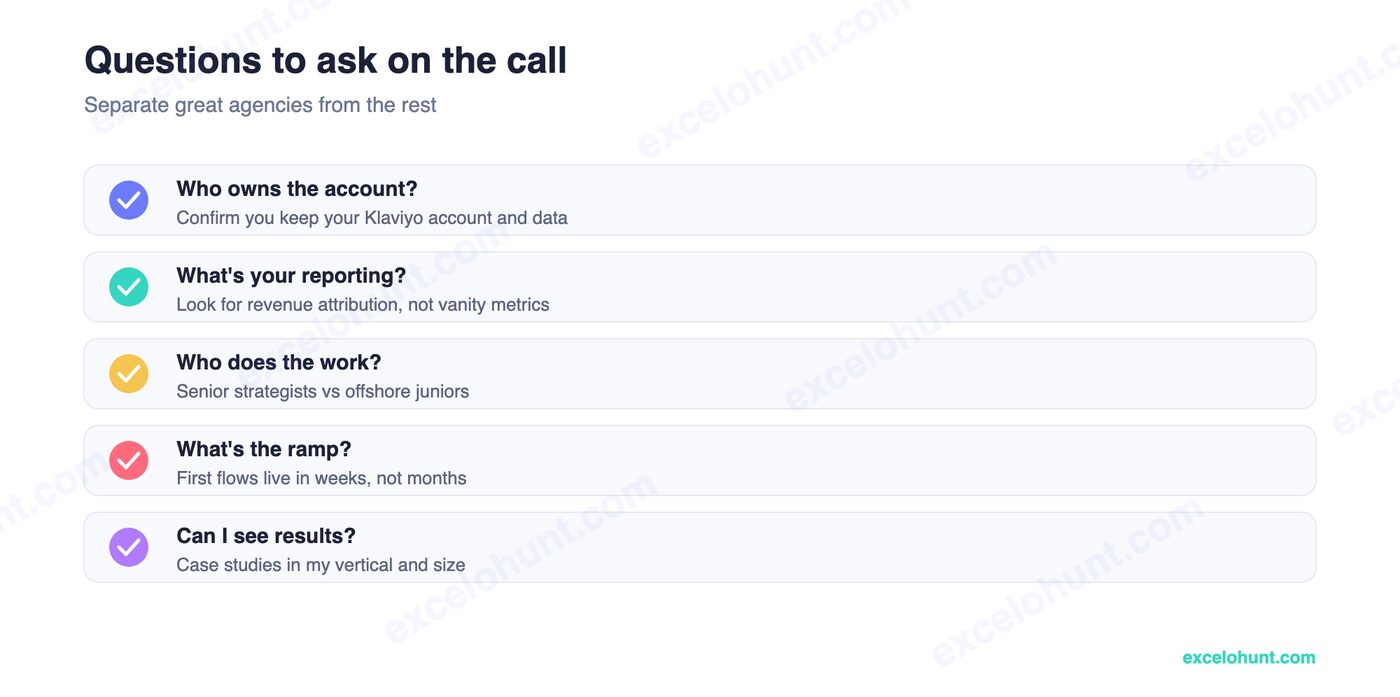
- “Who specifically will work on my account, and what’s their Klaviyo experience?”
- “Do I keep ownership of my Klaviyo account, list, and all assets if we part ways?”
- “How do you report results — what’s the headline metric you hold yourselves to?”
- “What does month one look like versus month six?”
- “Can you share results from a brand at my revenue stage?”
- “How do you handle deliverability and list health?”
- “What’s not included in the retainer?”
- “What’s the contract term and how do I exit?”
In our experience, the quality of the answer to “what’s not included” tells you the most — honest agencies are upfront about scope boundaries instead of implying everything is covered.
Red flags to avoid
Watch for guaranteed results, account lock-in, vanity-metric reporting, and no named strategist — these are the warning signs that an engagement will disappoint. A few specifics:
- “Guaranteed” revenue numbers before they’ve seen your account.
- Refusing to let you own your Klaviyo account or list.
- Reporting only opens and clicks, never attributed revenue.
- No clear point of contact or a constantly rotating team.
- Pressure to sign long lock-in contracts with no trial period.
For the full list and how to handle each, we wrote a dedicated guide on how agencies handle client reporting and the behaviours that should give you pause.
Treat these as patterns, not single strikes. One vague answer on a call is normal; a salesperson who guarantees a revenue lift, then dodges the ownership question, then talks only about open rates is showing you a consistent picture. The most expensive red flag is account ownership: if an agency sets up Klaviyo under its own control rather than yours, leaving later can mean losing access to your flows, segments, and even your list. Confirm in writing that you own the account, the data, and every asset built during the engagement — before you sign, not after.
Agency vs freelancer vs in-house
Your three options — agency, freelancer, or in-house hire — each fit a different stage, and the right choice depends on budget, bandwidth, and how much risk you can carry. A freelancer is cheapest but a single point of failure; in-house gives you control but is slow and expensive to build; an agency gives you a team and ICP-matched expertise for a predictable retainer.
| Model | Best for | Trade-off |
|---|---|---|
| Freelancer | Early brands, tight budgets | Limited bandwidth, continuity risk |
| In-house | Larger brands wanting full control | High cost, slow to staff, single-skill risk |
| Agency | $40k+/mo brands wanting a team | Retainer cost, requires good onboarding |
If you’re weighing these models seriously, our in-house vs agency guidance digs into the real costs and when each wins.
A useful rule of thumb: match the model to how busy and how revenue-critical your email program is. A light program of a few campaigns and core flows can be run well by a freelancer. A program that’s central to revenue — with a full flow suite, frequent campaigns, SMS, and active deliverability work — usually needs the breadth and redundancy of a team, whether that’s an agency or a fully staffed in-house function. And remember the decision isn’t permanent: many brands start with a freelancer to prove the channel, move to an agency as it scales, and only build in-house once email is large enough to justify several full-time specialists. Revisit the choice whenever your revenue roughly doubles.
Downloadable checklist
Save the 10-point checklist above and score each agency you talk to — anything below 7/10 needs a hard second look. Print it, paste it into your notes, and bring it to every intro call. The discipline of scoring (rather than going on gut feel) is what stops you from being swayed by a polished pitch. When you’re ready to put an agency through this checklist, book a call with us and hold us to all ten points.
Frequently asked questions
How do I choose an email marketing agency?
Define your goals and brand stage first, then run each agency through a 10-point checklist: ICP fit, platform expertise, transparent pricing, defined scope, real case studies, account and data ownership, revenue-tied reporting, a named strategist, clear communication, and fair contract terms. Choose the one whose specialism matches your stage.
What questions should I ask?
Ask who specifically will work on your account and their Klaviyo experience, whether you keep ownership of your account and list, how they report results, what month one versus month six looks like, and what is not included in the retainer. The answer to what’s not included is especially revealing.
What are red flags?
Guaranteed results before seeing your account, refusing to let you own your Klaviyo account or list, reporting only opens and clicks, no named point of contact, and pressure to sign long lock-in contracts. A pattern of these is a reason to walk away.
Agency vs freelancer — which is better?
It depends on your stage. Freelancers suit early brands on tight budgets but carry continuity risk; agencies suit $40k+/mo brands that want a full team and ICP-matched expertise for a predictable retainer. In-house works for larger brands wanting full control but is costly and slow to build.
About the author
Ravinder is the founder of Excelohunt, a Klaviyo-focused email & SMS agency that helps ecommerce brands grow revenue from email and SMS.
Ready to put an agency through this checklist? Get a free Klaviyo audit or see how we run email for brands.
More in Strategy
- Best Email Marketing Agencies for Small DTC Brands ($40k+/mo)
- Best Email & SMS Marketing Agencies for Ecommerce (2026)
- Chronos Agency Alternatives for $40k–$500k/mo DTC Brands
- Chronos Agency Pricing Explained: Is the $10k Minimum Worth It?
- Chronos Agency vs InboxArmy: Which Is Better for DTC Email?
Want Us to Implement This for Your Brand?
Get a free email audit and see exactly where you're losing revenue.
Get Your Free Audit