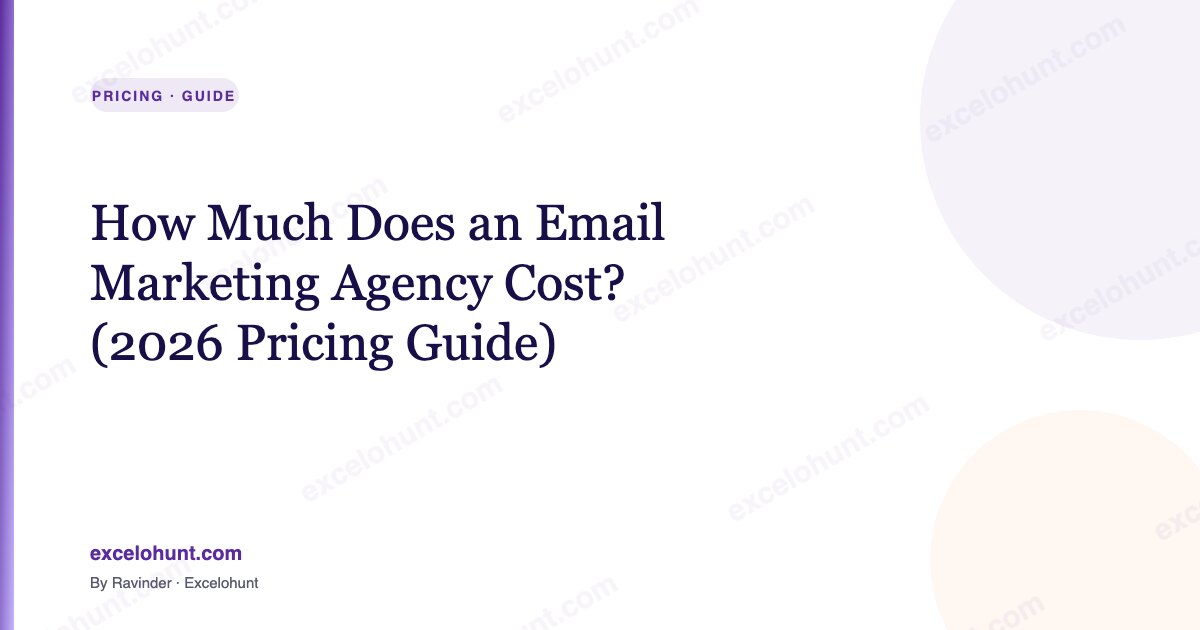
How Much Does an Email Marketing Agency Cost? (2026 Pricing Guide)
Quick answer: How much does email marketing cost with an agency? It depends on the model: freelancers and boutiques sit at the low end, mid-market managed agencies in the middle, and premium agencies at the top — with one published reference point being Chronos Agency at ~$10k/mo minimum (per Clutch) and a marketplace like Mayple from ~$1,280/mo. Most agencies quote custom / on request, so the real answer is a range driven by scope, brand size and whether you’re buying production or full lifecycle strategy.
Key takeaways
- How much does email marketing cost with an agency? A range, not one number — it’s set by model and scope.
- Freelancer/boutique → mid-market → premium is the spectrum; premium agencies often carry five-figure minimums.
- The only publicly sourced hard numbers: Chronos ~$10k/mo (per Clutch) and Mayple from ~$1,280/mo.
- Most agencies price custom / on request — judge value on revenue generated, not headline rate.
- A healthy email program targets roughly 3x ROI or better on the retainer.
If you’re budgeting for email and want a straight answer on cost, here’s how agency pricing actually works in 2026.
The short answer (price ranges)
How much email marketing costs with an agency has no single answer — cost is a range set by your engagement model and brand size. At the bottom sit freelancers and boutique collectives on project or hourly rates; in the middle, mid-market managed agencies on a monthly retainer; at the top, premium agencies with five-figure minimums. The two publicly sourced reference points are Chronos Agency (~$10k/mo minimum, per their Clutch profile) and Mayple (from ~$1,280/mo, per their site). Everything else is quoted custom.
We keep our own numbers transparent — see our pricing — precisely because so much of this market is opaque. The reason most agencies quote custom is genuine, not evasive: the cost of running email for a $40k/mo brand with three flows is very different from running it for a $400k/mo brand with twenty flows, two ESPs and a heavy SMS program. A single rate card can’t capture that, so agencies price to scope. That’s fine — but it means the headline number you hear from another brand rarely transfers to yours, and you should treat every quote as bespoke until you’ve matched it to your own scope.
What drives how much does email marketing cost?
How much email marketing costs is driven by scope, seniority and brand complexity far more than by any list price. The same logo can quote two brands very differently depending on what they need.
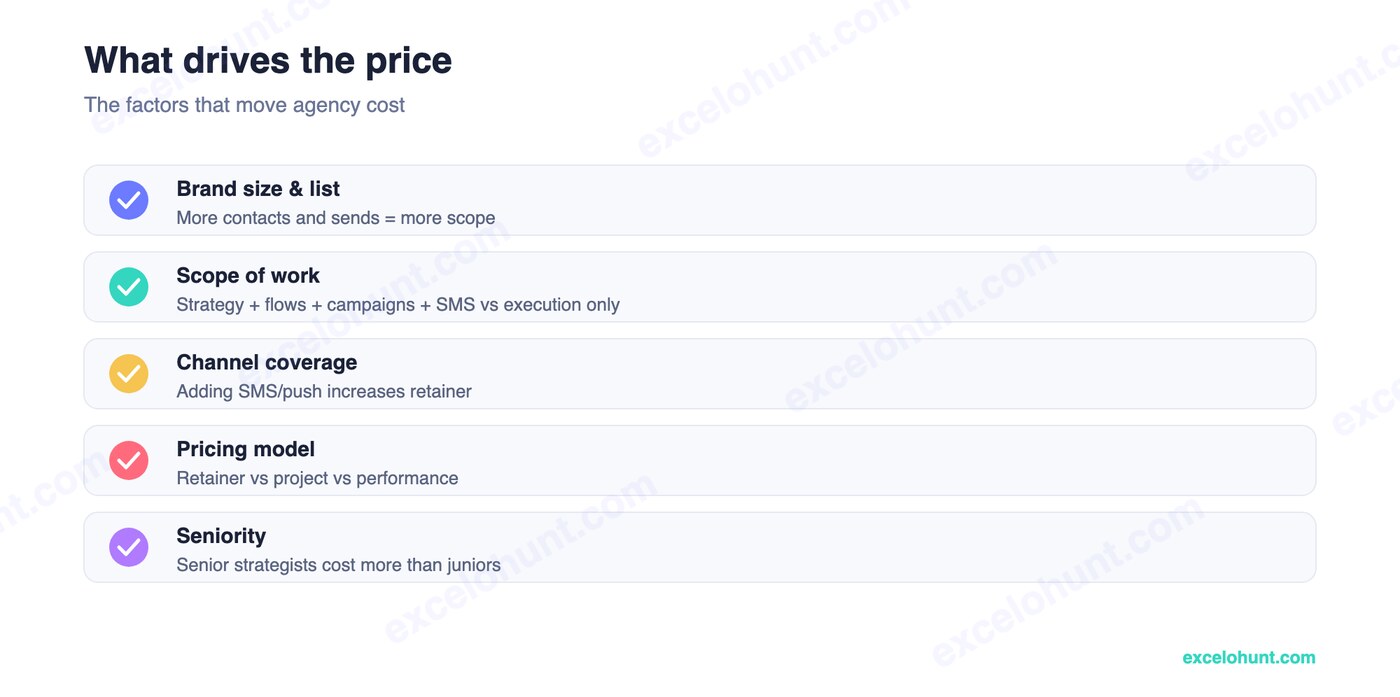
The main cost drivers we see in practice:
- Scope — production only (build the emails) vs full lifecycle (strategy, flows, campaigns, segmentation, reporting).
- Channel count — email alone, or email + SMS managed together.
- Send volume and complexity — campaign cadence, number of flows, segmentation depth.
- Seniority — a dedicated strategist costs more than a junior production resource.
- Brand size — bigger lists and revenue mean higher stakes and usually a higher retainer.
This is why a number quoted to another brand rarely transfers to yours. To make it concrete, consider two brands paying the same retainer. Brand A is a $50k/mo store wanting its core flows built and a steady campaign calendar; Brand B is a $250k/mo store wanting a heavy testing program, advanced segmentation, SMS and weekly reporting. The same fee buys very different things, and “expensive” only means something once you know which scope you’re buying. The corollary: when comparing quotes, normalize them to the same scope before you compare the prices, or you’ll compare apples to oranges. For the full mechanics, our email marketing agency pricing explained guide breaks each driver down.
Pricing models explained
Email agencies typically price one of three ways: a monthly retainer, a fixed-scope project, or a performance/hybrid model. Understanding which you’re buying matters more than the headline figure.
- Monthly retainer — the most common for managed programs. You pay a fixed monthly fee for an ongoing team that runs flows, campaigns and reporting. Predictable; best when email is a core channel.
- Project / fixed scope — a one-off build (e.g. a flow set, a migration, a template library). Good for a specific deliverable, not ongoing management.
- Performance / hybrid — a base fee plus a percentage of attributed email revenue. Aligns incentives but can get expensive as you scale, and attribution must be defined carefully (last-click vs Klaviyo-attributed vs incremental revenue can differ a lot).
A quick word on each model’s hidden trade-off. A retainer is predictable but you should confirm what happens in a quiet month — are deliverables fixed regardless of your launch calendar? A project looks cheap up front but buys you no ongoing ownership of results, so the revenue can stall once the build ends. And a performance model sounds risk-free until the channel scales, at which point the percentage can quietly become the most expensive option of the three. There’s no universally “best” model; there’s the one that fits how email sits in your business. If you’d prefer the in-house comparison instead, our DIY vs agency cost comparison weighs salary and tooling against a retainer.
Benchmark ranges
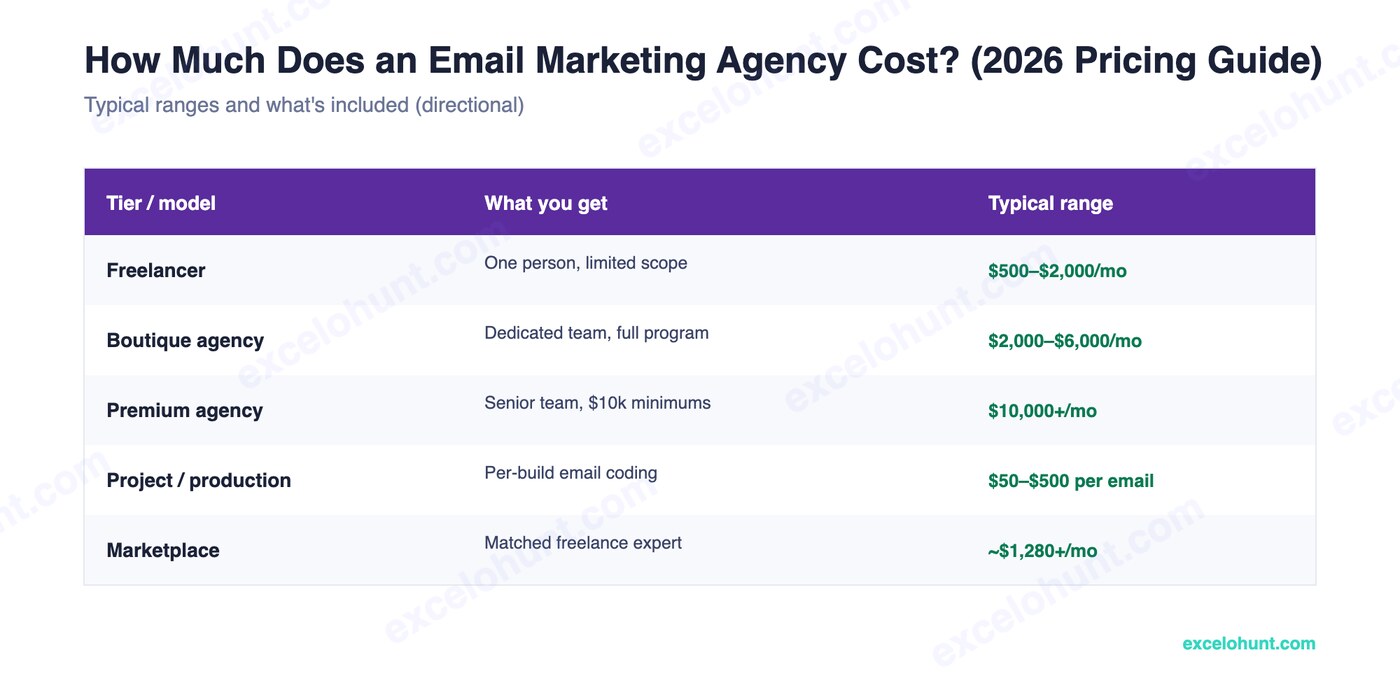
Use bands, not exact figures, to budget — because only two market reference points are public. The table below is the original, plain-English picture of how the market prices, with the sourced numbers clearly attributed.
| Tier | Typical buyer | Model | Reference price |
|---|---|---|---|
| Freelancer / boutique | Very early brands | Project or hourly | Custom / on request |
| Mid-market agency | $40k–$500k/mo DTC | Monthly retainer | Custom / on request |
| Premium agency | Established 6–7 figure brands | Retainer + minimum | Chronos ~$10k/mo (per Clutch) |
| Project-based | One-off builds | Fixed scope | Custom / on request |
| Marketplace | Founders wanting a match | Per-expert plan | Mayple from ~$1,280/mo |
As of July 2026. Only Chronos (~$10k/mo, $100–149/hr per Clutch) and Mayple (from ~$1,280/mo, per their site) publish or report hard numbers. All other cells are custom / on request — get a quote.
What you should get at each tier
The right question isn’t “how cheap?” but “what’s included for the price?” A low retainer that only ships templates can cost more in lost revenue than a higher one that runs the whole program.
At a boutique/freelancer tier, expect execution on a defined scope — builds, edits, maybe a flow or two — with you carrying more of the strategy and project management. At a mid-market managed tier, expect a dedicated team running strategy, core flows, the campaign calendar, segmentation and revenue reporting, so the channel is genuinely handed off. At a premium tier, expect all of that plus deeper experimentation, more senior strategists, and broader lifecycle work across email and SMS — which is precisely why five-figure minimums exist. As a Klaviyo agency, we sit in the managed band: done-for-you email and SMS with transparent pricing and a 3x ROI focus.
The mistake to avoid is reading price as a proxy for quality in either direction. A cheap engagement isn’t a bargain if it only ships templates and your revenue doesn’t move; a premium engagement isn’t “better” if its minimum is larger than your email channel can support. The right tier is the one whose included scope matches what your program actually needs this quarter — no more, no less. When you read a quote, map it to a deliverables list before you react to the number, and ask what specifically is excluded, since exclusions (SMS, design, copy, deliverability work) are where surprises hide.
Calculating ROI
Judge an agency on revenue generated, not on its rate — a higher retainer that returns 3x is cheaper than a low one that returns nothing. The simple model: estimate the incremental monthly revenue email will add (new flows, better segmentation, more campaigns), divide by the retainer, and you have your return multiple. A healthy program targets ~3x or better.
In our Klaviyo work, brands often move email from ~10% toward 25–35% of total revenue as flows and segmentation mature — which is where the retainer pays for itself many times over. A simple worked example: if a $100k/mo brand has email at 12% of revenue ($12k) and a strong program lifts it to 28% ($28k), that’s ~$16k/mo of incremental revenue. Against a mid-four-figure retainer, that’s comfortably a 3x-plus return — and crucially, it compounds, because flows keep earning every month with no extra send cost.
That’s also why the headline rate is the wrong thing to anchor on. A retainer that’s a few hundred dollars cheaper but returns nothing is far more expensive than one that’s slightly higher and returns 3x. Before you sign anywhere, build this back-of-envelope model with the agency’s own forecast, agree how revenue will be attributed, and set a checkpoint (say, 90 days) to confirm the channel is on the trajectory you priced for. If you want a concrete read on your upside, a free Klaviyo audit will show where the revenue is currently leaking, our case studies show the model in practice, and our guide to email marketing ROI for ecommerce helps you model the return before you commit.
Frequently asked questions
How much does an email marketing agency cost?
It’s a range set by model and scope, not a single figure. Freelancers and boutiques sit low, mid-market managed agencies in the middle, and premium agencies at the top. The only publicly sourced reference points are Chronos at ~$10k/mo (per Clutch) and Mayple from ~$1,280/mo; most agencies quote custom / on request.
What’s a typical Klaviyo agency retainer?
Most managed Klaviyo retainers are quoted custom / on request because they depend on scope, channel count and brand size. Rather than chase a single number, compare what’s included — strategy, flows, campaigns, segmentation and revenue reporting — and weigh it against the revenue it should generate.
Retainer vs performance pricing — which is better?
A retainer is predictable and best when email is a core, ongoing channel. Performance or hybrid pricing aligns incentives but can become expensive as you scale and requires carefully defined attribution. Most established programs run on a retainer with clear revenue reporting.
Is an email agency worth the cost?
It’s worth it when the program returns meaningfully more than it costs — typically a 3x or better ROI. Email and SMS often grow from ~10% toward 25–35% of revenue with a strong agency, so judge value on incremental revenue, not the headline rate.
About the author
Ravinder is the founder of Excelohunt, a Klaviyo-focused email & SMS agency that helps ecommerce brands grow revenue from email and SMS.
Want a transparent quote instead of “it depends”? Reviewed by Ravinderpal Singh. Get a free Klaviyo audit or see how we run email for brands.
All trademarks are the property of their respective owners. Excelohunt is not affiliated with or endorsed by the companies named on this page. Comparisons reflect publicly available information as of July 2026.
More in Strategy
- Best Email Marketing Agencies for Small DTC Brands ($40k+/mo)
- Best Email & SMS Marketing Agencies for Ecommerce (2026)
- Chronos Agency Alternatives for $40k–$500k/mo DTC Brands
- Chronos Agency Pricing Explained: Is the $10k Minimum Worth It?
- Chronos Agency vs InboxArmy: Which Is Better for DTC Email?
Want Us to Implement This for Your Brand?
Get a free email audit and see exactly where you're losing revenue.
Get Your Free Audit