In-House vs Email Marketing Agency: Which Is Right for You?
Quick answer: The in-house vs agency email marketing decision comes down to true cost, speed, and breadth of expertise. Building in-house gives you control but means salaries, tools, and a single skill set — often $90k–$150k+/year fully loaded for one marketer. An agency gives you a multi-skill team and proven playbooks for a predictable retainer, usually faster to results. In-house wins for very large brands; an agency wins for most $40k–$500k/mo DTC brands that want senior expertise without the overhead.
Key takeaways
- In-house vs agency email marketing is really a trade between control and breadth of expertise.
- True in-house cost is far above salary — add tools, benefits, hiring time, and single-person risk.
- An agency is usually faster to results because the playbooks and team already exist.
- In-house wins when email is huge, constant, and you can hire a full team.
- A hybrid model (in-house lead + agency execution) suits many growing brands.
If you’re deciding whether to hire an email marketer or bring in an agency, this guide — from Excelohunt founder Ravinderpal Singh and team — compares the true cost, speed, and expertise of each, and shows when a hybrid beats both.
The core trade-off
The fundamental choice is control versus breadth: in-house gives you a dedicated person who lives in your brand, while an agency gives you a team of specialists you don’t have to recruit, train, or retain. Neither is universally better. A single in-house marketer is rarely strong at strategy, design, copy, deliverability, and SMS all at once — yet a mature email program needs all five. An agency bundles those skills, but you trade some day-to-day proximity for them. The right answer depends on your revenue, how central email is, and whether you can realistically hire and keep top talent.
The decision matters more than it first appears because email and SMS aren’t a side channel for DTC brands — for many mature stores they drive a quarter to a third of total revenue. Get the staffing model right and you have a compounding revenue engine; get it wrong and you’ve either overspent on overhead you can’t use or under-resourced a channel that should be a top performer. That’s why it’s worth working through the true costs and trade-offs deliberately rather than defaulting to “hire someone” or “find an agency” on instinct.
True cost comparison
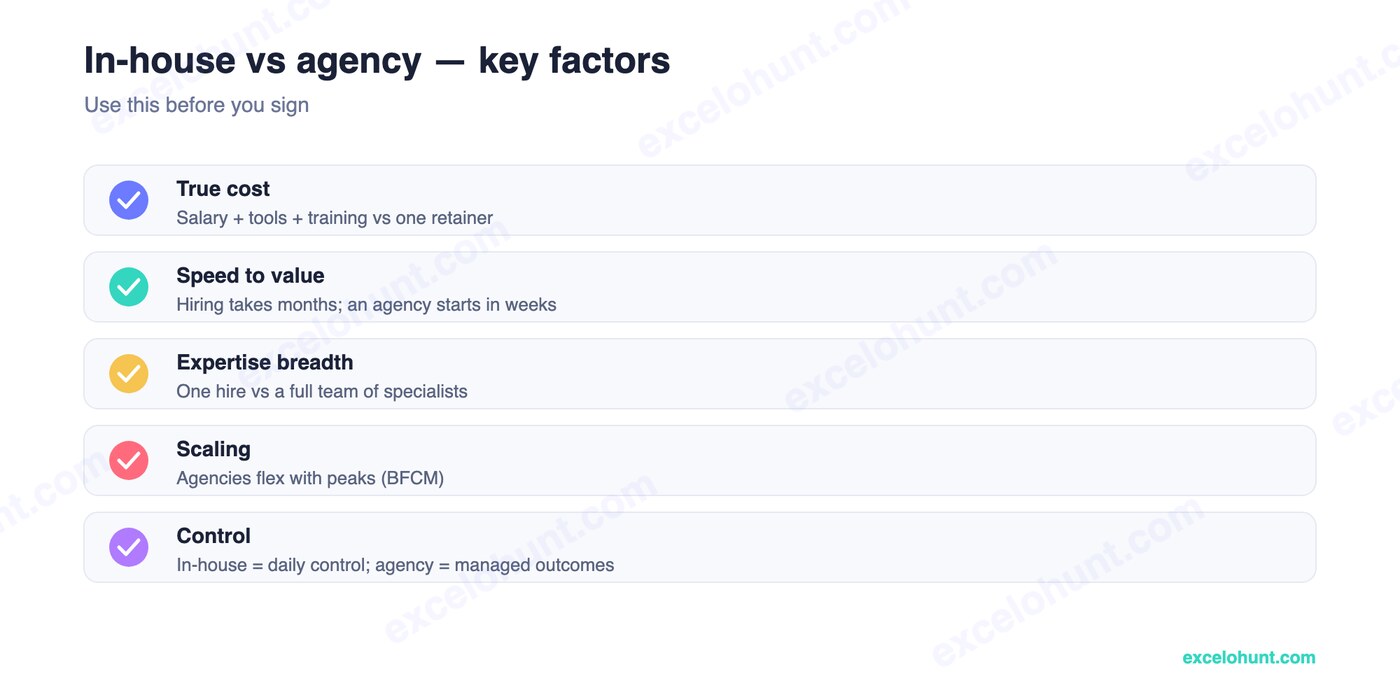
The true cost of in-house email is well above the headline salary — once you add benefits, tools, hiring time, and the risk of one person leaving, a single marketer often costs $90k–$150k+/year fully loaded. An agency retainer can deliver a broader skill set for a similar or lower all-in number, with no recruitment lag. Here’s the honest comparison:
| Cost factor | In-house hire | Email marketing agency |
|---|---|---|
| Direct cost | Salary $60k–$110k+ | Retainer ~$1,500–$10,000/mo |
| Benefits & overhead | +25–35% on salary | Included in retainer |
| Tools & subscriptions | You buy design, testing, SMS tools | Usually included |
| Hiring & ramp time | 1–3 months to hire, more to ramp | Live in weeks |
| Skill breadth | One person, one skill set | Strategist + designer + copy + ops |
| Continuity risk | High — one resignation stalls you | Low — team covers absences |
For a fuller numbers-led view, our DIY vs agency cost comparison and email marketing agency pricing explained lay out the retainer bands and how to read them.
It helps to think in terms of fully loaded cost rather than salary. If you hire an email marketer at $85,000, the real annual figure once you add payroll taxes, benefits, software, a laptop, and management time is comfortably north of $110,000 — before you’ve accounted for the months they spend ramping or the gap if they leave. Against that, a $4,000/month agency retainer is $48,000 a year for a strategist, designer, copywriter, and ops working as a unit, with the tools included. The headline comparison (“an agency costs $4k a month, that’s a lot”) flips the moment you load the in-house number honestly. The point isn’t that in-house is always more expensive — at large scale it can be efficient — it’s that the true comparison is rarely the one brands make at first glance.
Speed & expertise
An agency is usually faster to results because the playbooks, templates, and specialist team already exist — an in-house hire has to build all of that from scratch. When you hire one marketer, you’re betting on a single person’s range. When you engage a Klaviyo agency, you’re buying patterns proven across many brands. In our work across 500+ brands in 26+ verticals, the recurring lesson is that a new in-house hire spends their first quarter building flows and templates that an experienced team ships in weeks.
That said, expertise breadth cuts both ways. An agency’s strategist may know Klaviyo deeply but won’t know your product nuances on day one the way a dedicated employee eventually will. The fastest path for many brands is to combine the two — more on that below.
There’s also a depth-of-experience point that’s easy to miss. A single in-house hire learns from one brand: yours. An agency team sees patterns across dozens or hundreds of brands, so when your abandoned-cart revenue dips or your deliverability slips, they’ve likely diagnosed and fixed the same issue elsewhere. That cross-brand pattern recognition is hard to replicate with one employee, however talented. The flip side is institutional knowledge of your specific brand — your products, your customer, your voice — which an embedded employee accumulates over time and an agency has to be briefed on. The strongest programs find a way to capture both, which is why the hybrid model below is so common among scaling brands.
When in-house wins
In-house wins when email and SMS are a massive, constant revenue engine and you can afford to hire a full team, not just one person. If you’re a large brand sending daily, running complex segmentation, and needing real-time coordination with merchandising and creative, an embedded team earns its cost. Signs in-house is the right call:
- Email/SMS is already a top-three revenue channel at significant scale.
- You can hire 2–4 specialists (strategy, design, copy, ops), not just one generalist.
- You need tight, daily integration with product launches and inventory.
- You have the management bandwidth to lead and retain the team.
The trap is hiring one in-house marketer and expecting agency-level breadth. That single hire becomes a bottleneck the moment you need design, deliverability, and SMS simultaneously.
When an agency wins
An agency wins for most $40k–$500k/mo DTC brands that want senior, multi-skill expertise and predictable cost without the overhead of building and retaining a team. You get a strategist, designer, copywriter, and ops from day one, plus proven playbooks and accountability tied to revenue. Signs an agency is the right call:
- You’re between roughly $40k and $500k/mo and want to grow email/SMS fast.
- You can’t yet justify (or staff) a full in-house team.
- You want a team’s breadth, not one person’s range.
- You value a predictable retainer over salary plus benefits plus tools.
This is exactly the ICP we serve — see case studies for what that looks like in practice, and about Excelohunt considerations in our agency-selection guide.
There’s a speed dimension too. Hiring in-house typically means one to three months to find the right person, plus a ramp period before they’re shipping at full pace — so you might be six months out from a mature program. A good agency is usually live within weeks because the team, templates, and playbooks already exist. For a brand that wants email and SMS contributing meaningfully this quarter rather than next year, that head start often matters more than the per-month cost difference. In our work across 500+ brands in 26+ verticals, the brands that grow email fastest are almost always the ones that didn’t wait months to staff up.
Hybrid models
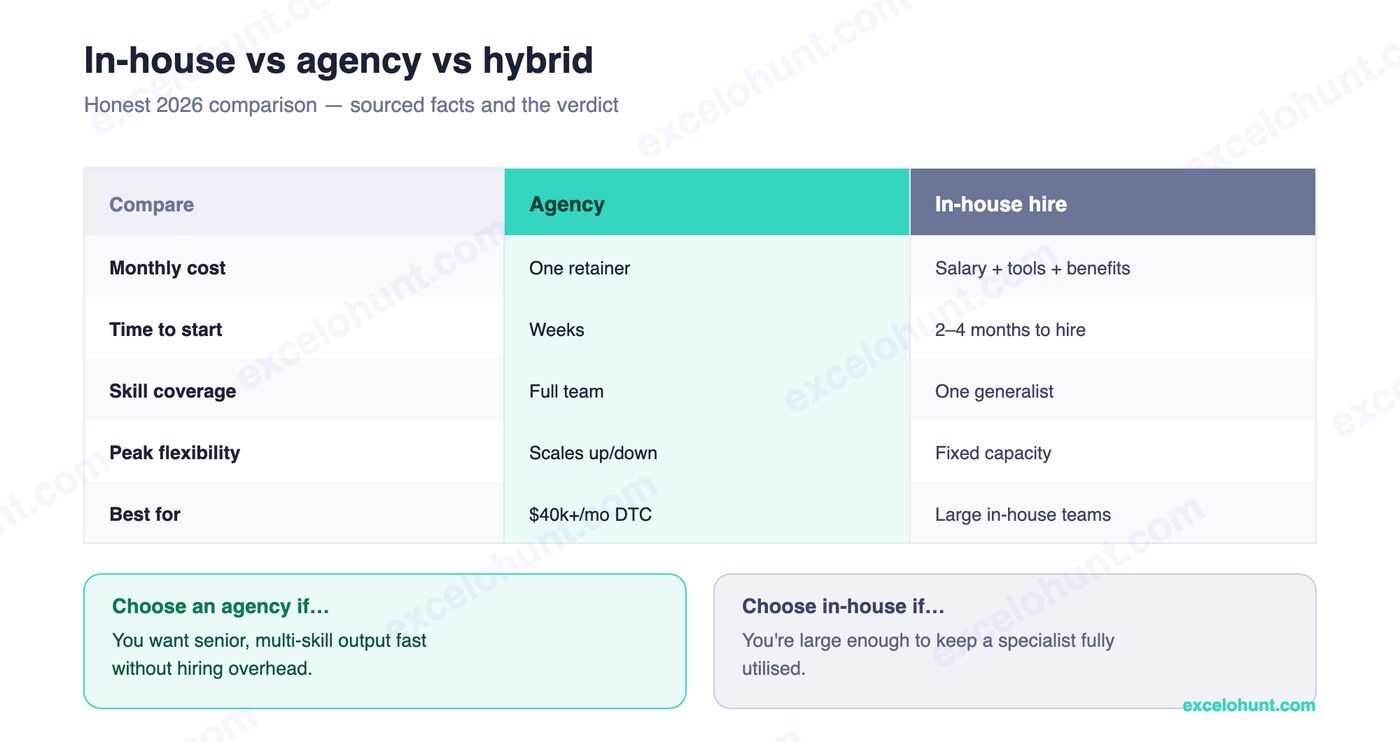
Many growing brands get the best of both worlds with a hybrid: an in-house lead who owns brand and strategy, plus an agency that executes flows, campaigns, design, and SMS at scale. This keeps brand knowledge close while borrowing a team’s breadth and bandwidth. The graphic below maps the three models side by side:
| Model | What it is | Best for |
|---|---|---|
| Fully in-house | Employed team owns everything | Large brands, email as core engine |
| Fully agency | Agency owns strategy + execution | $40k–$500k/mo brands wanting a team |
| Hybrid | In-house lead + agency execution | Growing brands keeping brand close |
In our experience the hybrid model scales beautifully: your in-house lead sets direction and guards the brand, while the agency absorbs the production load and brings cross-brand pattern recognition. It also de-risks the single-hire continuity problem.
A common progression looks like this. A brand starts fully in-house with one marketer, hits a bandwidth ceiling as campaign volume and SMS grow, and brings in an agency to execute — keeping the in-house person as the brand-and-strategy lead. Later, if email becomes a top revenue channel at large scale, some brands rebuild a full in-house team and taper the agency back. None of these stages is “wrong”; the right model is simply the one that matches your current revenue, how central email is, and the management bandwidth you have to lead people. Re-evaluate the decision each time your revenue roughly doubles, because the answer that was right at $40k/mo often isn’t the right one at $400k/mo.
Frequently asked questions
Should I hire in-house or an agency for email?
Hire in-house if email/SMS is already a large, constant revenue engine and you can staff a full team of specialists. Choose an agency if you’re a $40k–$500k/mo brand wanting senior, multi-skill expertise and predictable cost without recruiting and retaining a team. Many brands do best with a hybrid of an in-house lead plus an agency.
What does in-house email really cost?
Far more than the salary. A single marketer earning $60k–$110k typically costs $90k–$150k+/year fully loaded once you add benefits, tools, hiring time, and the risk of that one person leaving. That single hire also rarely covers strategy, design, copy, deliverability, and SMS well at once.
When does an agency make more sense?
When you want a team’s breadth — strategist, designer, copywriter, ops — from day one, at a predictable retainer, and you can’t yet justify a full in-house team. Agencies are usually faster to results because the playbooks and templates already exist, which suits most growing $40k+/mo DTC brands.
Can I do a hybrid model?
Yes, and many brands should. A hybrid keeps an in-house lead who owns brand and strategy while an agency executes flows, campaigns, design, and SMS at scale. It keeps brand knowledge close, borrows a team’s breadth, and removes the single-hire continuity risk.
About the author
Ravinder is the founder of Excelohunt, a Klaviyo-focused email & SMS agency that helps ecommerce brands grow revenue from email and SMS.
Not sure which model fits your stage? Get a free Klaviyo audit or book a call and we’ll give you an honest answer — even if that’s in-house. You can also see how we run email for brands.
More in Strategy
- Best Email Marketing Agencies for Small DTC Brands ($40k+/mo)
- Best Email & SMS Marketing Agencies for Ecommerce (2026)
- Chronos Agency Alternatives for $40k–$500k/mo DTC Brands
- Chronos Agency Pricing Explained: Is the $10k Minimum Worth It?
- Chronos Agency vs InboxArmy: Which Is Better for DTC Email?
Want Us to Implement This for Your Brand?
Get a free email audit and see exactly where you're losing revenue.
Get Your Free Audit