Freelancer vs Agency vs In-House: How DTC Brands Should Staff Klaviyo
Quick answer: In the Klaviyo freelancer vs agency decision, a freelancer is the cheapest and most flexible option but carries bandwidth and continuity risk; an agency costs more but brings a full team, redundancy, and proven playbooks; in-house gives maximum control at the highest fixed cost. For most DTC brands a freelancer fits the early proof-of-concept stage, while an agency becomes the better choice once email and SMS are a serious, growing revenue channel and reliability matters more than the lowest rate.
Key takeaways
- Klaviyo freelancer vs agency is a trade between cost on one side and reliability plus breadth on the other.
- Freelancers are cheapest (~$50–$150/hr or small monthly packages) but are a single point of failure.
- Agencies cost more but bring a team, redundancy, and cross-brand experience.
- In-house offers the most control at the highest, least flexible cost.
- Most brands graduate from freelancer to agency as email becomes mission-critical.
If you’re deciding how to staff Klaviyo, this guide compares a freelancer, an agency, and an in-house hire on cost, reliability, and risk — and shows when to move from one to the next.
The three staffing models
You have three realistic ways to run Klaviyo: a freelancer, an agency, or an in-house hire — and each suits a different stage of brand maturity. A freelancer is a single contractor you brief directly. An agency is a team (strategist, designer, copywriter, ops) operating as your outsourced email department. In-house is an employee or team you recruit and manage. The right pick depends on how central email and SMS are to revenue, how much reliability you need, and what you can spend.
It’s worth being clear about what each model actually is in practice. A freelancer is one person’s time and skill, bought by the hour or in a small monthly package — you manage them directly, brief them, and depend on their availability. An agency is a productised team: you hire the outcome, and behind it sit several specialists, shared documentation, and processes designed so no single absence breaks your program. In-house is the most embedded option — people on your payroll who live inside your brand daily but cost the most and take the longest to assemble. Most DTC brands move through these in sequence rather than picking one forever, so the useful question isn’t “which is best” in the abstract but “which fits where I am right now.”
Cost compared
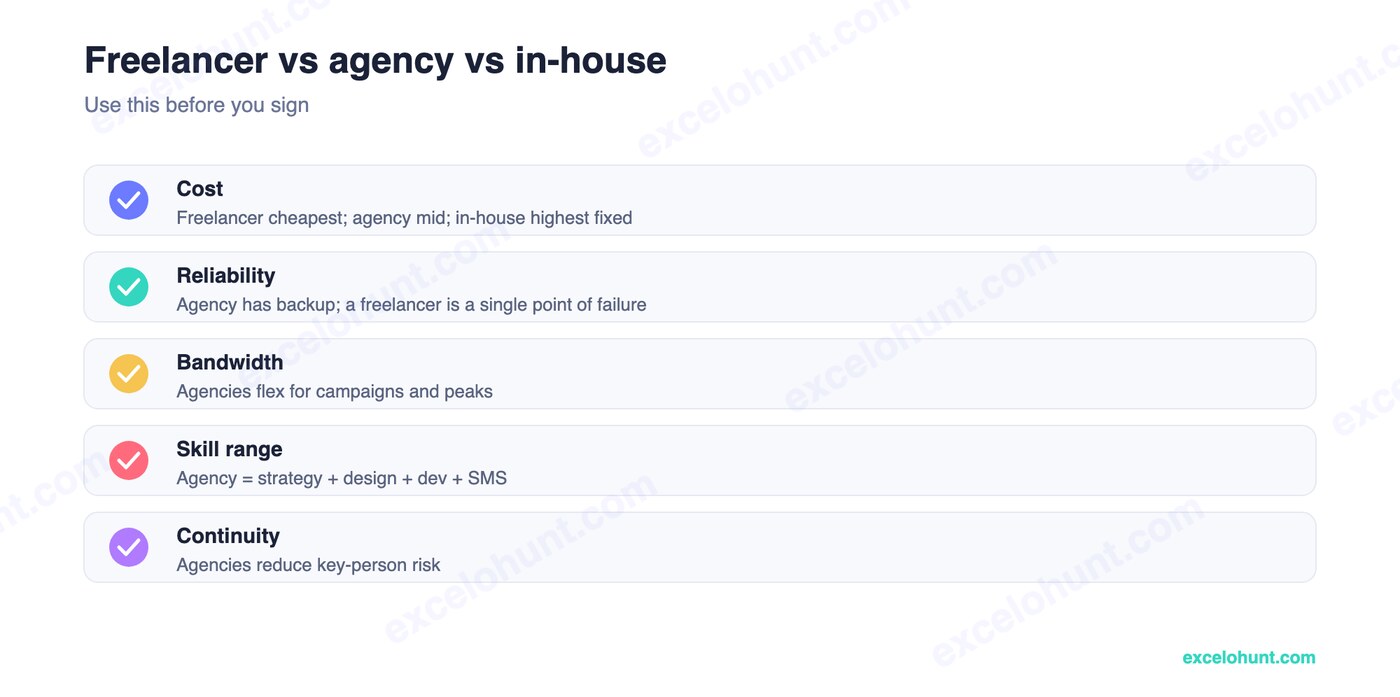
A Klaviyo freelancer is usually the cheapest option — roughly $50–$150/hour or small monthly packages — while an agency retainer runs higher but bundles a whole team, and in-house is the highest fixed cost once you load benefits and tools. Cheaper isn’t automatically better value, though: a low hourly rate that delivers thin strategy can cost you more in missed revenue than a higher retainer that grows the channel. Here’s the comparison:
| Factor | Freelancer | Agency | In-house |
|---|---|---|---|
| Typical cost | ~$50–$150/hr or small packages | ~$1,500–$10,000/mo retainer | $90k–$150k+/yr fully loaded |
| Skill breadth | One person | Full team | One to a few hires |
| Bandwidth | Limited, capped by hours | Scales with the team | Fixed to headcount |
| Continuity | Low — one person | High — team covers | Medium — resignation risk |
| Strategy depth | Varies widely | Cross-brand playbooks | Brand-deep over time |
For how retainers are structured and what each tier buys, see our email marketing agency pricing explained and DIY vs agency cost comparison guides.
The honest way to compare these costs is per unit of outcome, not per hour. A freelancer at $75/hour sounds cheap, but if it takes them 40 hours a month to ship what an agency pod delivers in coordinated parallel, you’re at $3,000 and you’ve got one person’s perspective rather than a team’s. Equally, the cheapest option genuinely is right at certain stages: a brand testing whether email is worth investing in at all shouldn’t sign a $5,000 retainer to find out. The mistake we see most often isn’t choosing the wrong model on day one — it’s failing to revisit the choice as the program grows, so a brand stays on a freelancer long after the channel has outgrown what one person can sustain.
Reliability & bandwidth
A freelancer’s biggest limitation is bandwidth — one person can only build so many flows and campaigns, and they take holidays, get sick, and juggle other clients. An agency solves this with a team: when one person is out, another covers, and capacity scales as your send volume grows. In our work running Klaviyo for 500+ brands, the most common reason a brand outgrows a freelancer isn’t quality — it’s that a single contractor simply can’t keep up once you’re shipping 12–16 campaigns a month plus a full flow suite plus SMS.
If your program is still light (a few campaigns and core flows), a strong freelancer is plenty. The moment email becomes a primary revenue channel with daily moving parts, bandwidth becomes the constraint a Klaviyo agency is built to remove.
Bandwidth limits also show up in quality, not just quantity. A freelancer at capacity tends to keep the lights on — sending the campaigns, maintaining the flows — but stops doing the higher-value work: testing subject lines, refining segments, analysing what’s underperforming, planning the next quarter. That strategic layer is the first thing to disappear when one person is stretched, and it’s precisely the work that grows revenue. An agency keeps strategy and production as separate streams, so the person planning your roadmap isn’t the same person racing to build this week’s campaign. That separation is a big part of why programs tend to accelerate after a brand moves from a solo freelancer to a team.
Risk & continuity
Continuity risk is the hidden cost of the freelancer model: if your one Klaviyo person disappears, your entire email program can stall overnight. A freelancer who stops responding, raises rates, or moves on takes their context with them — and if they controlled access, you can be locked out of your own account. Two safeguards matter regardless of model:
- You must own your Klaviyo account, list, and data — never let a freelancer or agency hold them hostage.
- Document the program — flows, segments, and reasoning should live with you, not in one person’s head.
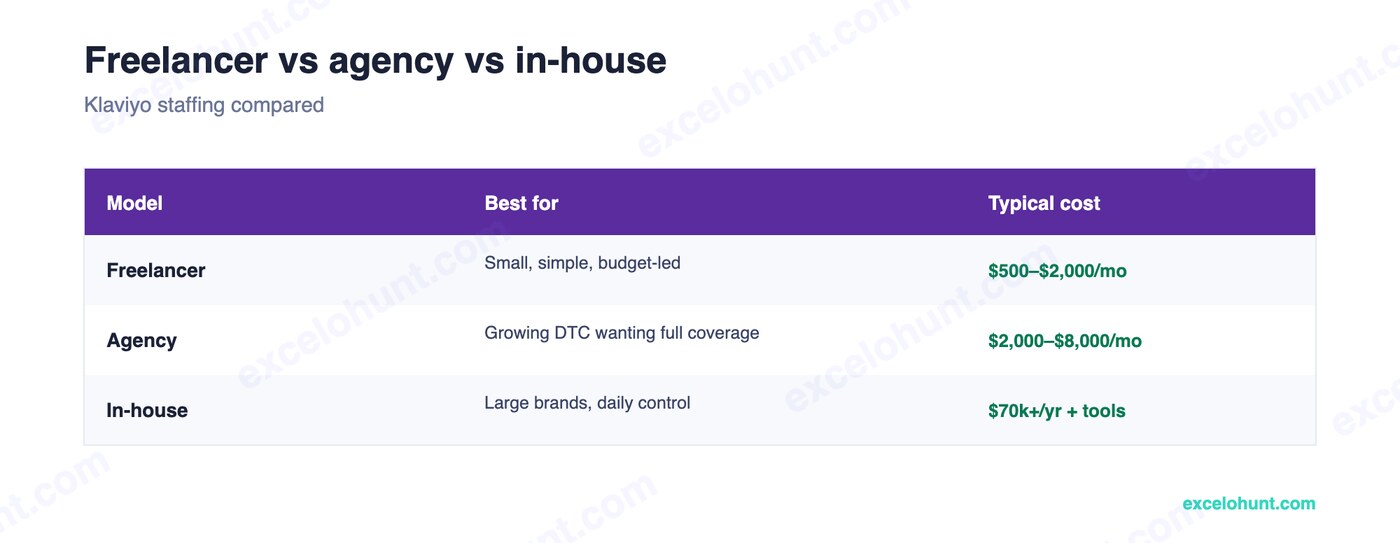
An agency reduces this risk structurally: the team shares context, documents the account, and one person leaving doesn’t break your program. That redundancy is a big part of what the retainer buys. The comparison graphic below sums up where each model lands on risk and fit:
When to use each
Use a freelancer to prove the channel cheaply, an agency once email/SMS is a serious growth lever, and in-house when you’re large enough to staff and lead a full team. A quick decision guide:
- Choose a freelancer if you’re early-stage, budget-tight, running a light program, and can tolerate some continuity risk.
- Choose an agency if you’re roughly $40k+/mo, want a team’s breadth and reliability, and need email/SMS to grow fast and predictably.
- Choose in-house if email is a top revenue channel at scale and you can hire and retain multiple specialists.
There’s no shame in starting with a freelancer — many great brands do. If you do decide to engage an agency, run it through our how to choose an email marketing agency checklist first. The mistake is staying with one past the point where bandwidth and continuity start costing you revenue. In-house, meanwhile, is rarely the right first move for a DTC brand: hiring a single full-time Klaviyo marketer is expensive and slow, and that one hire still can’t cover strategy, design, copy, deliverability, and SMS at once. In-house earns its place when email is a top revenue channel at real scale and you can staff and lead several specialists, not just one.
A simple way to decide: list the work your Klaviyo program needs over the next quarter — flows, campaign cadence, SMS, design, deliverability, reporting, and strategy — and ask honestly whether one person can deliver all of it reliably while you sleep at night. If the answer is yes and the budget is tight, a freelancer is the pragmatic choice. If the list already exceeds what one person can carry, or if losing that person would stall your revenue, you’ve effectively outgrown the freelancer model whether or not the current one is doing good work. Make the call on the work the program needs, not on how much you like your current contractor.
Why brands graduate to an agency
Most DTC brands graduate from a freelancer to an agency at the point where email and SMS become too important — and too busy — to rest on one person. The triggers we see repeatedly: campaign cadence outgrows one person’s capacity; you add SMS and need compliance and strategy; deliverability needs active management; or a freelancer departure leaves you exposed. An agency brings redundancy, cross-brand pattern recognition, and a strategist who owns the roadmap, all tied to a 3x ROI focus rather than billable hours.
Excelohunt is a Klaviyo Partner offering done-for-you email and SMS for DTC brands around $40k+/mo, with transparent pricing and a named founder, Ravinderpal Singh, behind the work. See the results in our case studies, and if you’re weighing the move, book a call — we’ll tell you honestly whether you’re ready for an agency or still better served by a freelancer. Our Klaviyo flows guide also shows the depth of work a mature program involves.
Frequently asked questions
Should I hire a Klaviyo freelancer or agency?
Hire a freelancer if you’re early-stage, on a tight budget, and running a light program you can tolerate some continuity risk on. Choose an agency once email and SMS are a serious, growing revenue channel and you need a team’s breadth, reliability, and proven playbooks. Many brands start with a freelancer and graduate to an agency.
Are Klaviyo freelancers reliable?
A strong freelancer can do excellent work, but reliability is structurally limited: one person has capped bandwidth and is a single point of failure if they get sick, take on other clients, or move on. Protect yourself by always owning your Klaviyo account, list, and data, and by keeping the program documented.
What’s cheaper — freelancer or agency?
A freelancer is almost always cheaper on paper, typically $50–$150/hour or small monthly packages, versus an agency retainer of roughly $1,500–$10,000/month. But value depends on results: a cheaper freelancer that grows the channel slowly can cost more in missed revenue than a higher retainer that scales it.
When should I move from freelancer to agency?
Move when email/SMS becomes mission-critical and busy — when campaign cadence outgrows one person, you add SMS, deliverability needs active management, or a freelancer departure would leave you exposed. At that point an agency’s redundancy, breadth, and strategy usually pay for the higher cost.
About the author
Ravinder is the founder of Excelohunt, a Klaviyo-focused email & SMS agency that helps ecommerce brands grow revenue from email and SMS.
Wondering if you’ve outgrown your freelancer? Get a free Klaviyo audit or see how we run email for brands.
More in Strategy
- Best Email Marketing Agencies for Small DTC Brands ($40k+/mo)
- Best Email & SMS Marketing Agencies for Ecommerce (2026)
- Chronos Agency Alternatives for $40k–$500k/mo DTC Brands
- Chronos Agency Pricing Explained: Is the $10k Minimum Worth It?
- Chronos Agency vs InboxArmy: Which Is Better for DTC Email?
Want Us to Implement This for Your Brand?
Get a free email audit and see exactly where you're losing revenue.
Get Your Free Audit