Optimite vs Chronos: Klaviyo Agencies Head-to-Head
Quick answer: In the Optimite vs Chronos comparison, both are Klaviyo-focused agencies, but they serve different brand stages. Chronos Agency is a premium, established lifecycle-marketing firm with a higher minimum spend — around $10k/mo per its Clutch profile — aimed at scaling and larger DTC brands. Optimite is a leaner Klaviyo email agency positioned for brands wanting focused, accessible email execution. Choose Chronos for enterprise-grade scope and budget; choose Optimite for a more accessible, email-led engagement.
Key takeaways
- Both are Klaviyo agencies, but Chronos targets premium/scaling DTC while Optimite targets more accessible, email-focused engagements.
- Chronos has a published floor: ~$10k/mo minimum and ~$100–149/hr per its Clutch profile — a clear signal of its enterprise tilt.
- Optimite’s pricing is custom / on request, positioned as a leaner alternative for brands not ready for a five-figure retainer.
- Service depth differs: Chronos spans email, SMS, and broader lifecycle/retention; Optimite leads with Klaviyo email execution.
- Fit is about brand stage and budget, not one being “better” — and there’s a third Klaviyo option worth comparing.
If you are shortlisting Klaviyo agencies, Optimite and Chronos often land on the same list despite sitting at different price points. Here is a fair, side-by-side comparison of their positioning, services, and pricing so you can match the right partner to your stage.
At a glance: Optimite vs Chronos
Both agencies work in Klaviyo, but Chronos is the premium, broad-scope option while Optimite is the leaner, email-led one. The table captures the headline differences; the sections that follow add the nuance behind each row.
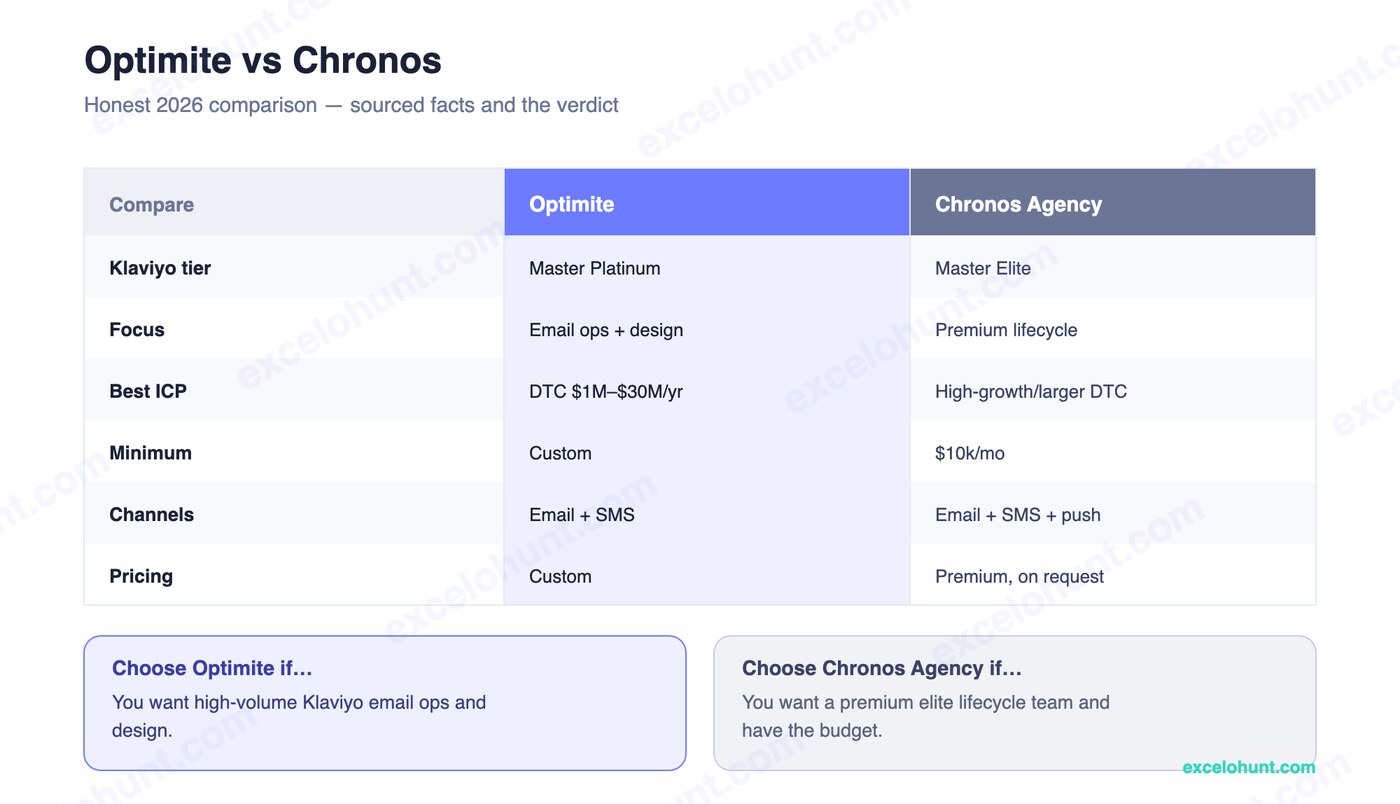
| Factor | Optimite | Chronos Agency |
|---|---|---|
| Positioning | Lean Klaviyo email agency | Premium lifecycle/retention agency |
| Core focus | Klaviyo email execution | Email, SMS, broader retention |
| Best for | Brands wanting accessible email help | Scaling & larger DTC brands |
| Minimum spend | Custom / on request | ~$10k/mo (per Clutch) |
| Hourly rate (where listed) | Custom / on request | ~$100–149/hr (per Clutch) |
| Platform | Klaviyo-centric | Klaviyo + multi-channel |
| Engagement | Focused email scope | Full lifecycle program |
The honest read: these aren’t direct substitutes. One is built for brands ready to invest at scale; the other for brands wanting focused execution without a five-figure commitment.
Both as Klaviyo partners
Each agency builds its work on Klaviyo, so the platform isn’t the differentiator — depth and breadth of service are. Per chronos.agency, Chronos positions itself as a retention and lifecycle-marketing firm spanning email and SMS, with case work skewed toward established DTC brands. That breadth — and the operational team behind it — is part of why its minimums sit higher.
Optimite, per optimite.ai, presents as a Klaviyo email agency with a tighter, execution-led focus. For a brand whose immediate need is well-built flows and campaigns rather than a sprawling multi-channel retention program, that focus can be an advantage: you are buying exactly the slice you need.
Klaviyo partner tiers (such as Master or Elite) are awarded based on certifications and performance and can change over time, so verify each agency’s current tier in the Klaviyo partner directory rather than relying on a snapshot. If you want to understand what the tiers actually signal, our Klaviyo flows guide and broader Klaviyo best practices explain the execution standards a strong partner should meet.
It’s worth being precise about what “Klaviyo agency” means in practice, because the label covers a wide range. At one end sit firms that treat Klaviyo as one tool within a multi-channel retention practice — they bring strategists, SMS specialists, and analysts, and Klaviyo is where a slice of the work lands. Chronos reads closer to this end. At the other end sit teams whose entire craft is Klaviyo email: building, testing, and refining flows and campaigns inside the platform, with less surface area beyond it. Optimite reads closer to this end. Neither is more “expert” in Klaviyo by default; they’re expert in different scopes. A scaling brand that needs SMS, retention strategy, and email coordinated benefits from the broader practice. A brand whose immediate gap is simply better Klaviyo email benefits from the focused one — and often pays less for not buying capabilities it won’t use yet.
Services and specialization
Chronos offers the broader, multi-channel lifecycle stack; Optimite specializes more narrowly in Klaviyo email — and that specialization is the real decision point. Chronos’ scope typically includes email, SMS, and retention strategy as an integrated program, which suits brands that want one partner owning the whole lifecycle. The trade-off is that broad programs come with broader budgets and a heavier engagement.
Optimite’s narrower focus means a brand can engage it for sharp Klaviyo email work without committing to a full multi-channel retention build. For an earlier-stage DTC brand, or one that already handles SMS elsewhere, that can be the more efficient choice.
A simple way to decide:
- You want one partner for email + SMS + retention strategy at scale → Chronos’ breadth fits.
- You want focused, well-executed Klaviyo email without a sprawling program → Optimite’s specialization fits.
- You want full done-for-you email and SMS but at a mid-market budget → worth comparing a third option (below).
One more practical lens: onboarding and reporting. A broader agency like Chronos typically runs a more structured onboarding — audit, strategy, roadmap — because it’s setting up a multi-channel program, and its reporting tends to span email, SMS, and retention metrics together. A focused email shop usually onboards faster and reports more narrowly on email performance, which is exactly what some brands want and not enough for others. Before signing with either, ask to see a sample report and a sample 90-day plan. Those two artifacts tell you more about how an agency actually works than any sales call, and they make the difference in scope between the two models concrete.
Pricing and minimums
This is where the two diverge most clearly: Chronos publishes a premium floor, while Optimite quotes custom. Per its Clutch profile, Chronos works to an approximate $10k/mo minimum and an hourly range of roughly $100–149/hr — figures that define it as an investment for brands with the revenue to support it. Optimite does not publish standard pricing, positioning itself as a more accessible, scope-dependent engagement; treat its cost as custom / on request.
| Pricing question | Optimite | Chronos Agency |
|---|---|---|
| Published minimum | Custom / on request | ~$10k/mo (per Clutch) |
| Hourly rate | Custom / on request | ~$100–149/hr (per Clutch) |
| Model | Scope-based | Retainer, premium tier |
| Best-matched revenue stage | Earlier / mid | Scaling / larger DTC |
Remember that a higher minimum is not “worse value” — for a large brand, a premium team can pay for itself. The question is whether your revenue and scope justify it. Our email marketing agency pricing explained guide covers how to weigh minimum spend against expected return. All figures here reflect publicly available information as of July 2026; confirm current pricing with each agency directly.
The clearest way to pressure-test a minimum is to translate it into a required return. A roughly $10k/mo retainer needs to generate well into five figures of incremental monthly revenue to clear a healthy ROI multiple. For a brand doing several hundred thousand a month, where email and SMS can plausibly drive a meaningful share of revenue, that math works comfortably. For a brand doing $40k–$60k/mo, the same retainer is a much larger slice of revenue and a riskier bet — not because the agency is worse, but because the spend is disproportionate to the base it’s working from. This is precisely why minimums exist: they’re the agency’s signal of the brand size it can serve profitably. Reading a minimum as a fit filter, rather than a price tag, leads to far better decisions on both sides.
Best by brand size
Match the agency to your stage: Chronos for scaling and larger DTC brands; Optimite for brands wanting accessible, focused Klaviyo email. Concretely:
- Sub-$40k/mo or email-only need: Optimite’s leaner, focused model is usually the more sensible starting point.
- Scaling brand wanting full lifecycle at scale: Chronos’ breadth and senior team justify the higher minimum.
- Mid-market DTC (~$40k–$500k/mo) wanting done-for-you email + SMS without a $10k floor: neither is a perfect fit, which is exactly the gap a third option fills.
A third Klaviyo option
If Chronos feels too premium and you want more than a focused email-only scope, a dedicated mid-market Klaviyo agency is the third option to weigh. That is where Excelohunt fits — offered here as a neutral third comparison, not a winner of this head-to-head. We run done-for-you email and SMS for DTC and ecommerce brands at roughly $40k+/mo, with published, transparent pricing rather than a five-figure minimum.
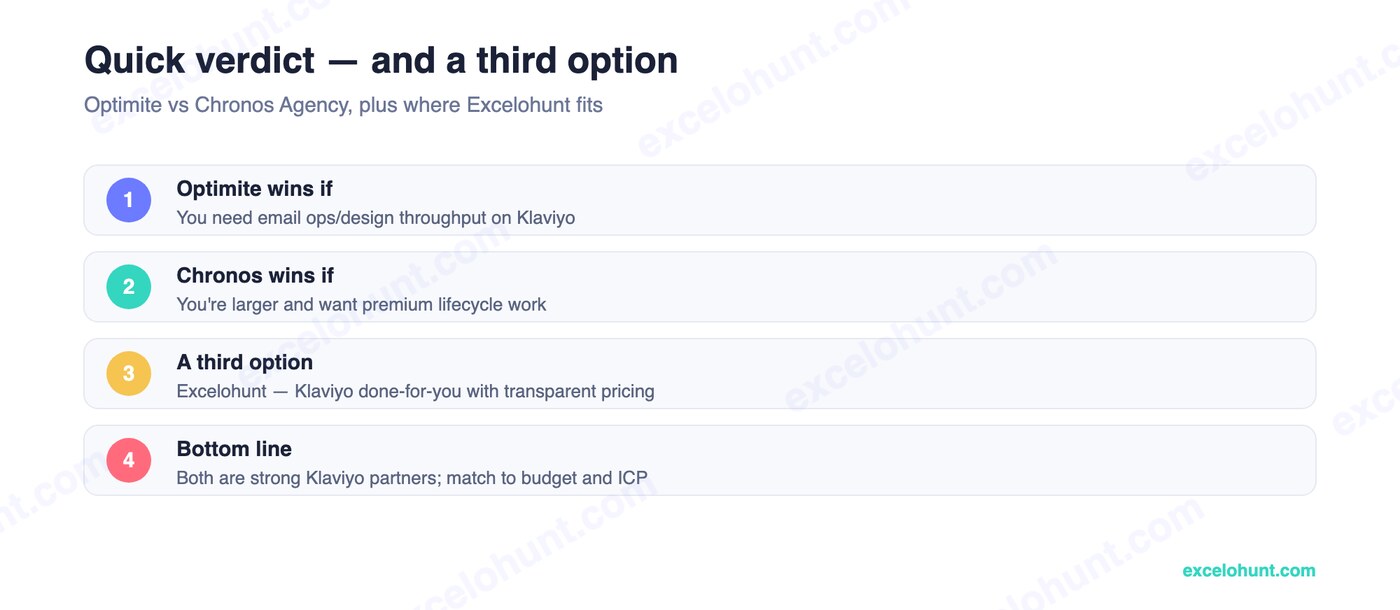
As a Klaviyo Partner serving 500+ brands across 26+ verticals with a 3x ROI focus, our model sits deliberately between Optimite’s focused execution and Chronos’ premium breadth: a full, accountable email and SMS program at a mid-market budget with transparent pricing. If that profile matches your brand, a free Klaviyo audit is the quickest way to see where your flows stand, and you can read what a dedicated Klaviyo agency actually does day to day. You can also read about founder Ravinderpal Singh and how we think about email marketing ROI for ecommerce. For broader options, see our Klaviyo alternatives overview. The right pick is the one whose model and budget match your stage — compare all three on fit, not on hype.
Frequently asked questions
Optimite or Chronos for Klaviyo?
Both work in Klaviyo, so the choice is about scope and budget. Chronos suits scaling and larger DTC brands wanting a broad email, SMS, and retention program at a premium investment. Optimite suits brands wanting focused, accessible Klaviyo email execution without a five-figure minimum.
What are their Klaviyo partner tiers?
Klaviyo partner tiers are awarded on certifications and performance and can change over time, so verify each agency’s current tier in the official Klaviyo partner directory. Both present as Klaviyo-focused agencies; treat any specific tier as something to confirm directly rather than assume.
Which is better value?
Value depends on your stage. For a large brand needing full lifecycle marketing, Chronos’ premium team can pay for itself. For a smaller or email-only brand, Optimite’s leaner, focused model is likely better value. A higher minimum isn’t worse value — it has to match your revenue and scope.
What other Klaviyo agencies should I compare?
Beyond Optimite and Chronos, it’s worth comparing dedicated mid-market Klaviyo agencies such as Excelohunt that offer full done-for-you email and SMS with published pricing. Compare agencies on ICP, services, partner tier, and pricing model rather than name recognition alone.
About the author
Ravinder is the founder of Excelohunt, a Klaviyo-focused email & SMS agency that helps ecommerce brands grow revenue from email and SMS.
Comparing Klaviyo agencies? Get a free Klaviyo audit or see how we run email for brands.
All trademarks are the property of their respective owners. Excelohunt is not affiliated with or endorsed by the companies named on this page. Comparisons reflect publicly available information as of July 2026.
More in Strategy
- Best Email Marketing Agencies for Small DTC Brands ($40k+/mo)
- Best Email & SMS Marketing Agencies for Ecommerce (2026)
- Chronos Agency Alternatives for $40k–$500k/mo DTC Brands
- Chronos Agency Pricing Explained: Is the $10k Minimum Worth It?
- Chronos Agency vs InboxArmy: Which Is Better for DTC Email?
Want Us to Implement This for Your Brand?
Get a free email audit and see exactly where you're losing revenue.
Get Your Free Audit