Quick answer: A Klaviyo browse abandonment flow emails shoppers who viewed a product but never added it to cart. It’s lower-intent than cart abandonment, so keep it light — usually one or two emails, no discount — triggered by a “Viewed Product” event once you’ve enabled onsite tracking. Filter out anyone already in the cart flow so you don’t double-email the same shopper.
Key takeaways
- Browse abandonment is lower intent than cart abandonment — treat it gently (1–2 emails, usually no discount).
- It requires onsite tracking active (the Klaviyo snippet + “Viewed Product” event firing).
- Filter out shoppers already in the cart flow so they don’t get two overlapping sequences.
- Show the exact product they viewed via a dynamic block — relevance is the whole point.
- Expect smaller recovery than cart abandonment, but it’s incremental revenue you weren’t capturing.
Plenty of shoppers browse a product, get distracted, and never come back — without ever adding to cart, so your cart flow never fires. The Klaviyo browse abandonment flow catches that earlier signal. This is a cluster of our complete Klaviyo flows guide.
Browse abandonment vs cart abandonment: what’s the difference?
Browse abandonment triggers on viewing a product; cart abandonment triggers on starting checkout. That difference in intent changes everything about how you treat them:
- Cart abandonment = high intent. They were ready to buy. Push harder (three emails, eventually a discount). See the existing Klaviyo abandoned cart flow guide.
- Browse abandonment = lower intent. They were curious. A gentle nudge, usually without a discount, is appropriate — being too aggressive here feels intrusive and trains discount-seeking.
Think of browse abandonment as the top of the recovery funnel and cart abandonment as the bottom.
What onsite tracking does browse abandonment need?
The flow can’t fire without active onsite tracking — Klaviyo needs to record a “Viewed Product” event tied to a known email address. Two requirements:
- The Klaviyo onsite snippet (active onsite tracking) is installed. On Shopify this comes with the native integration; on other platforms you add the JavaScript. For the platform-by-platform setup, see the Klaviyo Shopify integration guide.
- The visitor is identified. Browse tracking works for people Klaviyo can recognize — subscribers who’ve clicked an email, or visitors identified via a form. Anonymous first-time visitors can’t be emailed.
That second point is why browse abandonment volume is naturally smaller than cart: you can only message shoppers you already know.
How to build the browse abandonment trigger
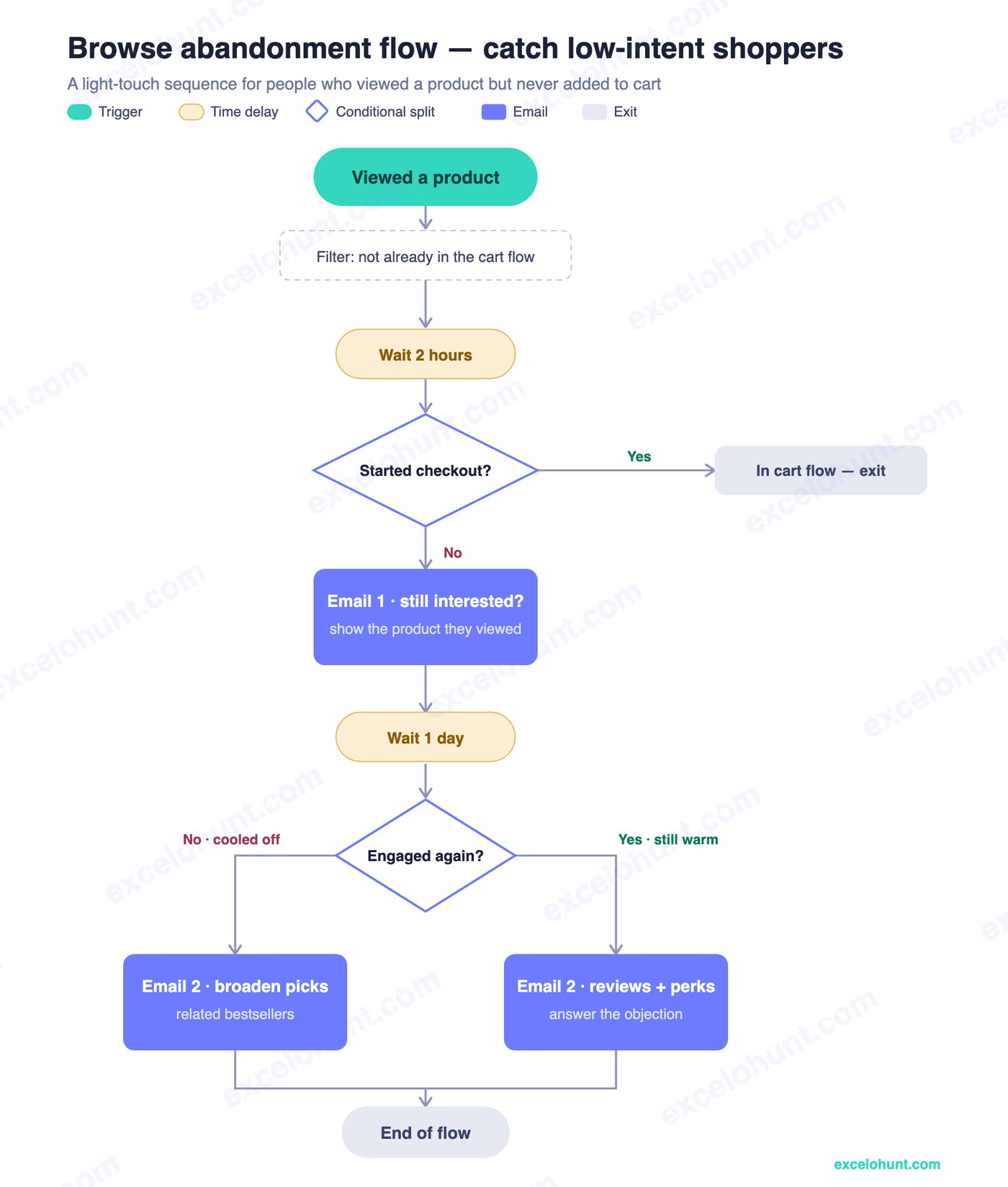
Trigger the flow on the “Viewed Product” metric. The diagram shows the recommended logic, including the filter that prevents overlap with your cart flow.
Key build details:
- Flow filter: “has not started checkout since” — so a shopper who progresses to cart leaves the browse flow and enters the higher-intent cart flow instead.
- Short delay: wait a couple of hours, not days — browse intent decays quickly.
- Dynamic product block: populate the email with the specific product they viewed (and a few related items), so it’s instantly relevant.
Timing and frequency (keep it light)
- Email 1: ~2 hours after the view — “still thinking it over?” featuring the viewed product.
- Email 2 (optional): ~1 day later, only if they didn’t return — broaden to related bestsellers for the cooled-off shopper, or add reviews/benefits for the still-warm one.
One or two emails is plenty. Browse abandonment is a nudge, not a campaign.
Copy that doesn’t feel creepy
Because you’re emailing about something they only looked at, tone matters:
- Frame it as helpful, not surveillant. “Here’s a closer look at [product]” beats “We saw you looking at [product].”
- Lead with the product and its benefits, then a soft CTA. No urgency or discount in email one.
- Answer the objection in a second email — reviews, sizing help, or a benefit that overcomes hesitation.
Suppressing cart-abandoners (avoid overlap)
The most common browse-flow bug is double-emailing. If a shopper views a product, then adds to cart, they could be in both flows at once. Prevent it with the flow filter above (“has not started checkout since entering”) so the cart flow always takes priority. The two flows should hand off cleanly, never run in parallel.
Results to expect
Browse abandonment recovers less than cart abandonment — the intent is lower and the audience smaller — but it’s incremental revenue you weren’t capturing at all, at near-zero ongoing cost. Measure it on revenue per recipient and the share of viewers who return and convert. For where it sits among your other automations, see the complete flows guide, and Klaviyo’s browse abandonment documentation for setup specifics.
Frequently asked questions
What’s the difference between browse and cart abandonment?
Browse abandonment triggers when someone views a product; cart abandonment triggers when they start checkout. Browse is lower intent, so it gets a lighter touch (1–2 emails, usually no discount), while cart abandonment justifies a longer, more incentivized sequence.
Does Klaviyo browse abandonment need onsite tracking?
Yes. The flow fires on a “Viewed Product” event, which requires Klaviyo’s active onsite tracking installed and the visitor to be identified (a known subscriber). Anonymous first-time visitors can’t be emailed.
How many emails should a browse abandonment flow have?
One or two. It’s a gentle nudge, not a hard-sell sequence — being too aggressive about something a shopper only viewed feels intrusive.
Should a browse abandonment flow offer a discount?
Usually not. Reserve discounts for higher-intent moments like cart abandonment. Lead with the product and its benefits; discounting a casual browser trains discount-seeking and erodes margin.
About the author
Ravinderpal Singh is the founder of Excelohunt, a Klaviyo-focused email & SMS agency. The browse abandonment setup here comes from flows we’ve built and audited.
Want every abandonment flow live and de-duplicated? Book a free Klaviyo audit.
More in Klaviyo
- 12 Best Klaviyo Agencies in 2026 (Honest Comparison)
- Klaviyo Agency Pricing: What You Should Pay in 2026
- Optimite Alternatives: Klaviyo Email Agencies Compared (2026)
- How to Set Up Klaviyo: Complete Setup Guide (Step-by-Step)
- How to Use Klaviyo: A Beginner's Guide (2026)