Klaviyo Segments: How to Build High-Converting Segments
Quick answer: A Klaviyo segment is a dynamic group of subscribers defined by conditions — purchase history, engagement, browsing behavior, predicted value — that updates in real time as people qualify and drop out. Unlike a static list, a segment maintains itself. The 10 segments below (engaged, VIPs, repeat buyers, non-buyers, at-risk, and more) drive the most revenue and protect your deliverability.
Key takeaways
- A list is a static container you add people to; a segment is a live query that updates itself.
- Build engaged segments first — they’re what you send to when you want to protect deliverability.
- The 10 must-have segments cover the whole lifecycle: VIPs, engaged 30/60/90-day, first-time vs repeat, at-risk, category interest, discount-only, and unengaged.
- Use dynamic segments for almost everything; static lists only for fixed imports.
- Good segmentation isn’t just higher conversion — it’s how you keep landing in the inbox.
Klaviyo’s real advantage over a basic email tool is its data. Segments are how you turn that data into more relevant, higher-converting sends — and how you protect your sender reputation. This guide is a cluster of our complete Klaviyo flows guide.
Segments vs lists: what’s the difference?
A list is a static group you add people to (e.g., everyone who signed up via your popup). A segment is a dynamic group defined by rules that Klaviyo re-evaluates continuously. If you create a segment of “opened an email in the last 30 days,” people enter and leave it automatically as their behavior changes — you never maintain it by hand.
Practical rule: use a list as the entry point (your newsletter list that your signup form feeds), and use segments for everything you target — campaigns, flow filters, and suppression. Lists are where people land; segments are how you reach the right ones.
The 10 must-have Klaviyo segments
These ten cover the audiences that drive the most revenue and best protect deliverability. Build them once and reuse them everywhere.
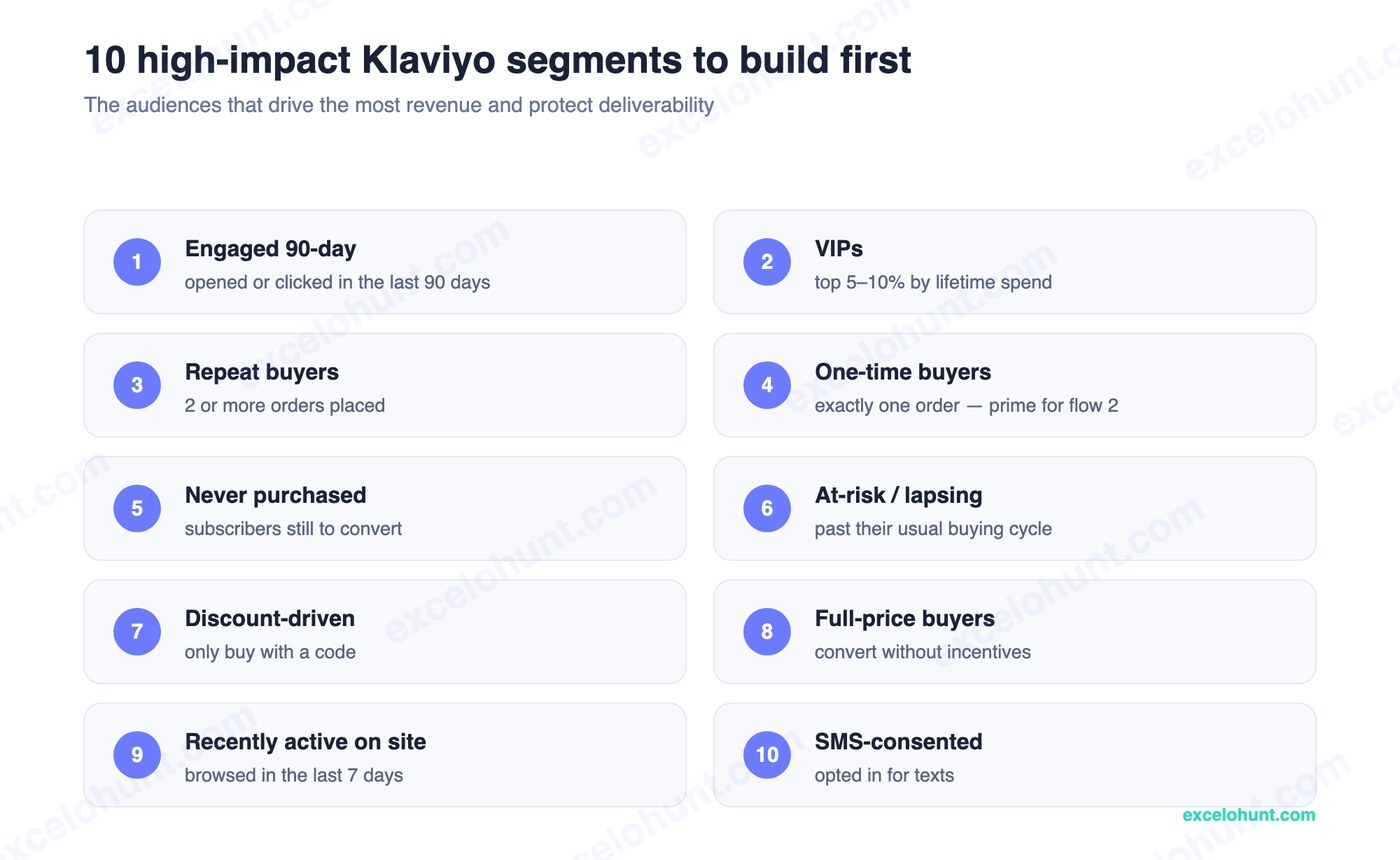
- Engaged (30/60/90-day) — opened or clicked recently. Your safest audience to send to.
- VIPs — top 5–10% by lifetime spend. Reward and retain them.
- Repeat buyers — 2+ orders. Cross-sell and loyalty.
- One-time buyers — exactly one order; prime for a second-purchase push.
- Never purchased — subscribers still to convert.
- At-risk / lapsing — past their usual buying cycle; feed your winback flow.
- Discount-driven — only buy with a code; target carefully to protect margin.
- Full-price buyers — convert without incentives; don’t over-discount them.
- Recently active on site — browsed in the last 7 days; high intent.
- SMS-consented — opted in for texts; your audience for SMS campaigns.
How to build a segment in Klaviyo (step-by-step)
- Go to Audience → Lists & Segments → Create Segment.
- Choose your definition — e.g., “What someone has done (or not done)” → Opened Email → “at least once in the last 30 days.”
- Add conditions with AND / OR logic. For an engaged-buyer segment, combine “opened email in last 60 days” AND “placed an order at least once.”
- Name it clearly (e.g.,
Engaged 60d) and save. The count populates immediately and stays live.
Definitions can combine behavior, purchase history, predicted metrics (CLV, churn risk), and profile properties — which is where Klaviyo’s depth shows.
Dynamic vs static segments
- Dynamic segments update automatically as people meet or stop meeting the conditions. Use these for nearly everything.
- Static segments / lists are fixed snapshots — useful only for one-off imports or a frozen audience you don’t want changing.
When in doubt, dynamic. A self-maintaining audience is the whole point.
Using segments in flows and campaigns
- In campaigns: send to a segment, not your whole list. Targeting “engaged 90-day + category interest” beats blasting everyone — higher conversion, lower unsubscribes.
- In flows: use segments as flow filters and conditional splits. For example, split a welcome flow on “first-time vs repeat” so only new subscribers get the first-purchase code.
- For suppression: exclude your unengaged segment from big sends to protect deliverability.
How segmentation protects deliverability
Sending to engaged segments first is the single biggest lever you have over inbox placement. Mailbox providers watch how people interact with your emails; when you consistently send to people who open and click, your sender reputation rises and everything lands better. Blast an unsegmented list and you train the algorithms to filter you. This is why segmentation and deliverability are two sides of the same coin. Klaviyo’s segmentation documentation covers every condition type in detail.
Frequently asked questions
What’s the difference between a list and a segment in Klaviyo?
A list is a static group you add people to; a segment is a dynamic group defined by rules that Klaviyo re-evaluates continuously, so people enter and leave automatically as their behavior changes. Use lists as entry points and segments to target sends.
What are the most important Klaviyo segments to build?
Start with engaged (30/60/90-day) segments and VIPs, then add first-time vs repeat buyers, at-risk customers, and an unengaged segment for suppression. These drive the most revenue and protect deliverability.
Are Klaviyo segments dynamic or static?
Most should be dynamic — they update automatically as customers qualify or drop out. Static segments are only useful for fixed imports or a frozen audience you don’t want changing.
How do segments improve email deliverability?
By letting you send to people who actually engage. Mailbox providers reward consistent positive engagement with better inbox placement, so sending to engaged segments first lifts your sender reputation and helps all your emails land.
About the author
Ravinderpal Singh is the founder of Excelohunt, a Klaviyo-focused email & SMS agency. The segments here are the ones we build first in every account we run.
Want expert segmentation set up in your account? Book a free Klaviyo audit.
More in Klaviyo
- 12 Best Klaviyo Agencies in 2026 (Honest Comparison)
- Klaviyo Agency Pricing: What You Should Pay in 2026
- Optimite Alternatives: Klaviyo Email Agencies Compared (2026)
- How to Set Up Klaviyo: Complete Setup Guide (Step-by-Step)
- How to Use Klaviyo: A Beginner's Guide (2026)