Quick answer: Klaviyo SMS marketing lets you send text messages from the same platform as your email, with shared flows and segments. To run it: register for A2P 10DLC, collect explicit opt-in consent (an unchecked checkbox with clear terms, per TCPA), then add SMS to high-intent flows like abandoned cart and use it sparingly for time-sensitive campaigns. SMS gets ~98% read rates, so reserve it for urgency — not everyday sends.
Key takeaways
- Klaviyo unifies email + SMS in one platform — shared flows, segments, and reporting.
- Compliance is mandatory: A2P 10DLC registration + explicit, logged consent (TCPA).
- Use SMS for urgency and high intent (cart, back-in-stock), not daily broadcasts.
- Always include STOP/HELP and respect quiet hours and frequency caps.
- SMS is read in minutes — powerful, but easy to overuse.
SMS is the highest-engagement channel you have, and Klaviyo makes it work alongside email instead of in a silo. This guide covers setup, the compliance you can’t skip, and the flows that actually print revenue. It’s a cluster of our complete Klaviyo flows guide.
Why email and SMS work better together
Email and SMS do different jobs, and Klaviyo lets one flow use both. Email carries rich content and storytelling at near-zero cost; SMS delivers urgent, time-sensitive nudges that get read in minutes. The division of labour:
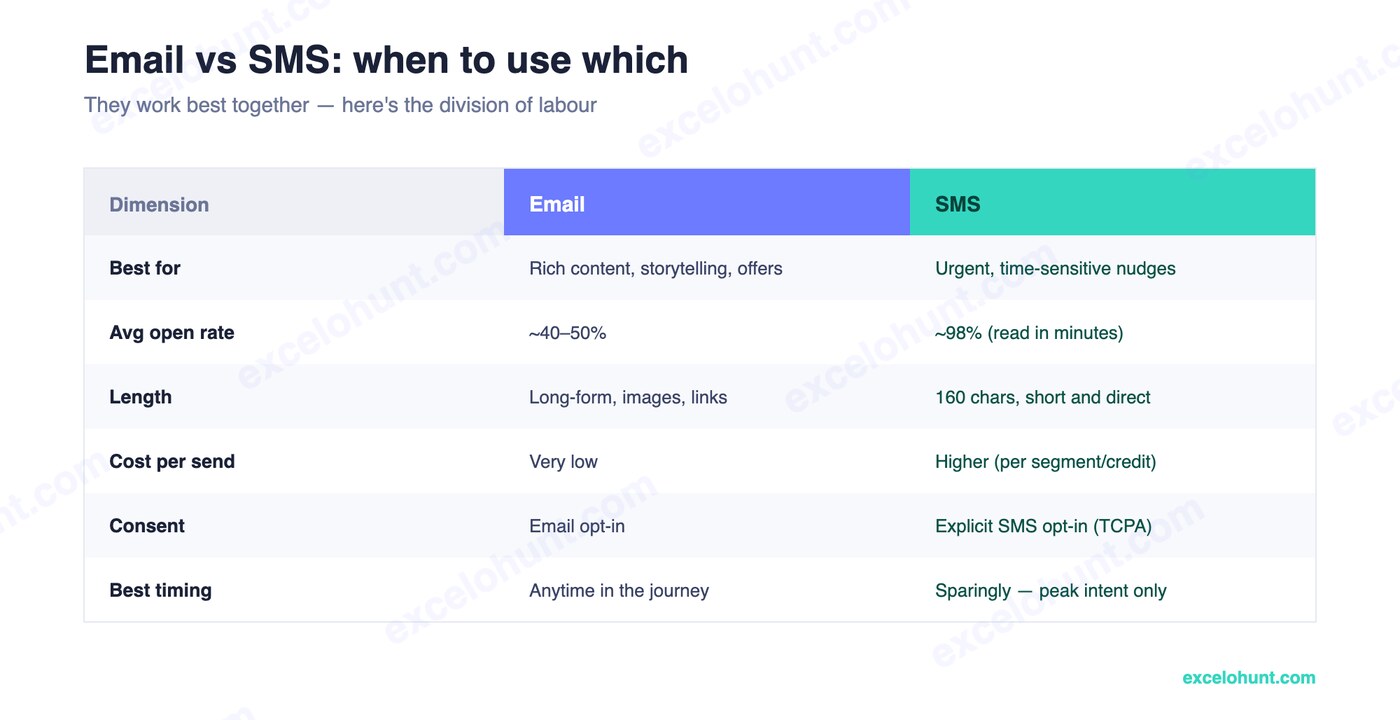
Because they share segments and flows in Klaviyo, you can (for example) send an abandoned-cart email, then an SMS nudge 30–90 minutes later to consented subscribers — coordinated, not duplicated.
Setup and registration (A2P / TCPA basics)
Before you send a single text:
- Register for A2P 10DLC — US carriers require brand and campaign registration for application-to-person messaging. Klaviyo guides you through it; approval can take a few days.
- Get a sending number (a local number, toll-free, or short code depending on volume).
- Understand TCPA — US law requires prior express written consent to text someone for marketing. Non-compliance carries real penalties, so this isn’t optional.
Collecting compliant consent
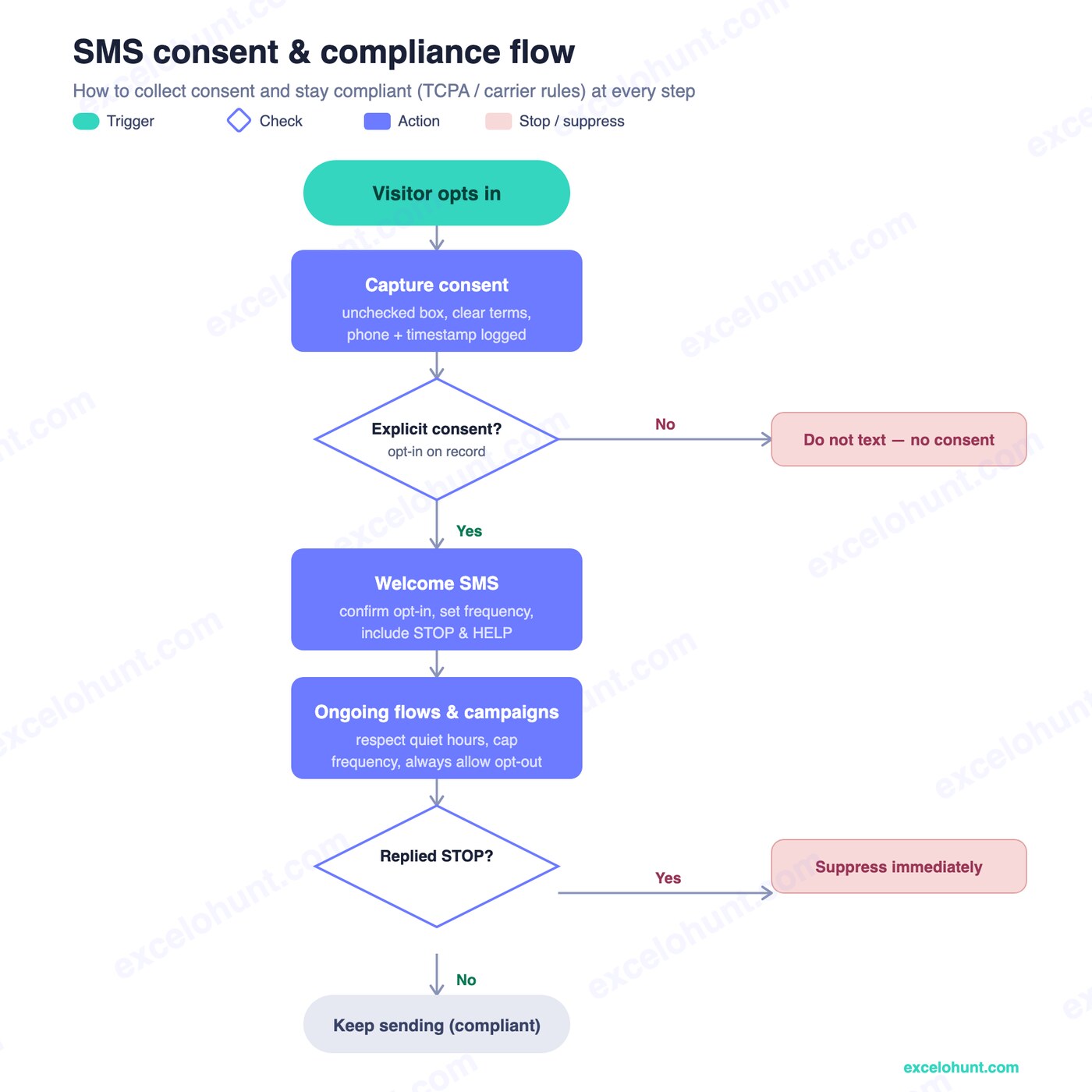
This is the part most stores get wrong. The flow below shows compliant consent capture and ongoing compliance:
The rules:
- Explicit consent — an unchecked checkbox with clear terms, never pre-ticked. Log the phone number and timestamp.
- No consent = never text. Don’t import phone numbers you can’t prove opted in.
- Welcome SMS confirms the opt-in, sets frequency expectations, and includes STOP and HELP.
- Ongoing: respect quiet hours, cap frequency, always allow opt-out — and a STOP reply must suppress immediately.
Capture consent with a multi-step signup form (email first, phone second).
Essential SMS flows
Layer SMS into your highest-intent flows:
- Abandoned cart — an SMS 30–90 minutes after the email, for consented subscribers, lifts recovery.
- Back-in-stock — SMS is perfect for “it’s back” alerts; demand is proven and urgency is real.
- Shipping/post-purchase — order and delivery updates keep customers informed (and opted in).
- Winback — a single well-timed SMS can reactivate where email gets ignored.
SMS campaign ideas
Use SMS campaigns sparingly, for genuine urgency: flash sales, last-chance reminders, early VIP access, and product drops. Because read rates are so high, over-texting burns goodwill fast — quality and timing over volume.
When to use SMS vs email
Reserve SMS for time-sensitive, high-intent moments and keep email as your workhorse for content and everyday sends. A good rule: if it isn’t urgent or personal, it’s an email. The benchmark table above is your quick reference.
Benchmarks and costs
- Read rate: ~98%, usually within minutes.
- Cost: higher than email, billed per message/segment and by region — so target tightly.
- Track revenue per SMS recipient and unsubscribe rate; if opt-outs climb, you’re sending too often. Klaviyo’s SMS documentation covers setup and compliance specifics.
Frequently asked questions
Is Klaviyo good for SMS marketing?
Yes — Klaviyo unifies email and SMS in one platform, so they share flows, segments, and reporting. That coordination (e.g., an SMS nudge after a cart email) is its main advantage over standalone SMS tools for most brands.
What consent do I need for Klaviyo SMS?
Explicit, prior written consent under TCPA — an unchecked checkbox with clear terms, with the phone number and timestamp logged. You also need A2P 10DLC registration. Never text numbers you can’t prove opted in.
When should I use SMS instead of email?
Use SMS for time-sensitive, high-intent moments — abandoned cart nudges, back-in-stock alerts, flash sales, shipping updates. Keep email for content and everyday sends. SMS read rates are ~98%, so overusing it drives opt-outs.
How much does Klaviyo SMS cost?
SMS is billed on top of your email plan, per message and segment, and varies by region. Because it’s pricier than email, target tightly and reserve it for high-value moments.
About the author
Ravinderpal Singh is the founder of Excelohunt, a Klaviyo-focused email & SMS agency. Unified email + SMS is our specialty.
Want compliant SMS that prints revenue? Book a call and we’ll set it up right.
More in Klaviyo
- 12 Best Klaviyo Agencies in 2026 (Honest Comparison)
- Klaviyo Agency Pricing: What You Should Pay in 2026
- Optimite Alternatives: Klaviyo Email Agencies Compared (2026)
- How to Set Up Klaviyo: Complete Setup Guide (Step-by-Step)
- How to Use Klaviyo: A Beginner's Guide (2026)
Want Us to Implement This for Your Brand?
Get a free email audit and see exactly where you're losing revenue.
Get Your Free Audit