Klaviyo Welcome Flow: Build a Series That Converts
Quick answer: A Klaviyo welcome flow is an automated email (and SMS) series triggered the moment someone subscribes. It introduces your brand, delivers any signup offer, and converts new subscribers into first-time buyers. Three emails is the proven baseline — email one immediately, then +2 days and +4 days — and top welcome flows hit ~50% open rates and ~10% placed-order rates.
Key takeaways
- The welcome flow is usually the highest-ROI automation you can build — new subscribers are at peak intent.
- Trigger on list join (from your signup form), not on a segment, so it fires the instant someone subscribes.
- 3 emails is the sweet spot; extend to 4–6 only if later sends keep converting.
- Give a first-purchase discount only to people who haven’t bought — split on order history.
- Benchmark to beat: ~50% open, ~15% click, ~10% placed-order on the series.
The Klaviyo welcome flow is the first automation every store should turn on, and the one that most consistently pays for itself. A new subscriber has just raised their hand — they’re more likely to open, click, and buy in the next few days than at almost any other point. This guide covers the trigger, the number of emails, the discount decision, segmentation, and the benchmarks to measure against. It’s a cluster of our complete Klaviyo flows guide.
Why is the welcome flow your highest-ROI automation?
Because it reaches people at the moment of maximum interest — right after they chose to hear from you. Welcome emails earn the highest engagement of any flow: open rates around 50% are normal, roughly double a typical campaign. That attention is a one-time window, and the welcome flow is how you convert it into a first order before interest cools.
It also sets the relationship. The first few emails teach subscribers what to expect, establish your brand voice, and frame why you’re worth buying from — which lifts the performance of every flow and campaign that follows.
What triggers a Klaviyo welcome flow — signup form or list?
Trigger on list membership — specifically, “when someone is added to your newsletter list.” Your Klaviyo signup form or popup adds subscribers to that list, which fires the flow instantly.
Avoid triggering off a segment for a welcome series: segment-triggered flows can behave unpredictably as people qualify and re-qualify. A list-join trigger is clean — one entry, one welcome. If you collect subscribers from multiple sources (popup, checkout opt-in, footer form), you can either point them all to one list or branch the flow by source (more on that below).
How many emails should a welcome series have?
Three is the proven baseline, sent over the first few days. Based on data across thousands of ecommerce accounts, three emails captures the bulk of the available revenue without fatiguing new subscribers. Extend to four, five, or six only if you can see the later emails still converting.
A reliable structure:
- Email 1 — immediate: Welcome them, deliver the signup offer (if any), and set expectations. This is your highest-open email; lead with value.
- Email 2 — +2 days: Brand story and social proof — reviews, press, founder note. Build the reasons to trust you.
- Email 3 — +4 days: Bestsellers or a category guide that points to product. If they still haven’t bought, this is where a gentle deadline on the offer can help.
The diagram below shows the full logic, including the splits that make it work — checking whether someone is a new vs existing customer, and routing buyers out before you discount them twice.
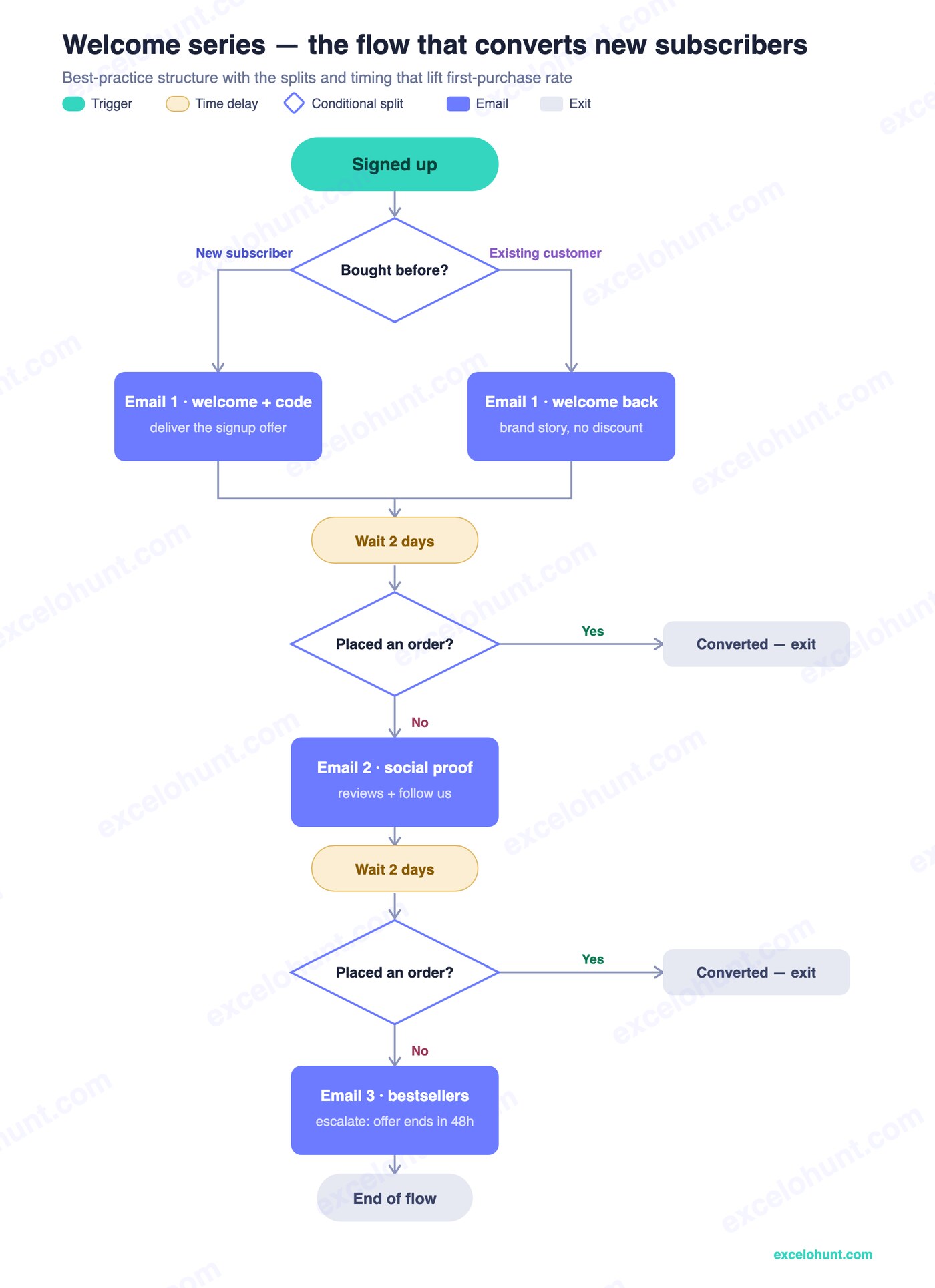
Notice the “placed an order?” check before each send — once someone buys, they exit, so you never keep nudging a customer who’s already converted.
Should you offer a first-purchase discount?
Offer it only to subscribers who haven’t purchased before. Split the flow on “has placed an order at least once over all time.” New subscribers who are genuinely new get the first-purchase code; people who were already customers (and happened to re-subscribe) get a no-discount, brand-story version instead. This protects your margin and stops you training the list to expect a discount for existing.
If you don’t want to lead with a discount at all, withhold it and escalate: introduce a time-limited offer in the last email, only for subscribers who still haven’t bought. That gives people a chance to convert at full price first.
How to segment the welcome flow by source or interest
If subscribers arrive from very different places — a quiz, a specific product page, a giveaway — a one-size welcome underperforms. Klaviyo tracks signup source via the $source property; use a Conditional Split on it near the top of the flow to branch by where someone actually signed up:
- Popup subscribers (the majority): the standard 3-email structure above works as-is — moderate purchase intent, no special handling needed.
- Quiz subscribers: higher intent — they’ve told you what they want. Reference their quiz answers and recommend the specific products the quiz pointed to, and skip generic education content since they’ve already engaged with it. Personalized quiz-based paths convert meaningfully higher than a generic welcome.
- Checkout opt-in subscribers: these people are already buying — don’t give them a first-purchase discount code. Route them into a post-purchase-style welcome that thanks them and introduces the brand without the sales push.
- Footer/blog subscribers: lower intent, interested in content more than buying. Lead with brand story and education, and delay the incentive to a later email rather than the first.
- By interest: if your form captures a preference (e.g., menswear vs womenswear), split on that property and show relevant products throughout.
Good segmentation here compounds across your whole account — see our guide to building high-converting Klaviyo segments.
What to A/B test first
In priority order, since welcome-flow revenue is concentrated in email 1:
- Email 1’s subject line — highest volume, highest impact. Test personalized vs. generic, direct vs. creative.
- Incentive type — percentage off vs. free shipping vs. a free gift. Free shipping often outperforms a percentage discount for stores with AOV under ~$80; above that, percentage discounts tend to win.
- Email 1’s featured products — bestsellers vs. new arrivals vs. highest-margin items. Let the data decide.
- Timing gaps — tighter sequences (day 1/2/4) convert faster but can fatigue smaller lists; test against a slightly longer cadence.
- Series length — three emails is the baseline, but test extending to five or six once you can see the later sends still converting.
Welcome email benchmarks: open, click, conversion
Use these as directional targets for the series (segmented, engaged subscribers):
| Metric | Healthy benchmark |
|---|---|
| Open rate | ~45–55% |
| Click rate | ~10–15% |
| Placed-order rate | ~8–10% |
| Revenue per recipient | Track and improve over time |
If your welcome flow is well below these, the usual culprits are a weak first email, no offer where the audience expects one, or sending to an unsegmented list. Klaviyo’s own welcome series guide is a useful reference for setup, and the broader numbers live in Klaviyo’s email benchmarks.
Common Klaviyo welcome flow mistakes
- Delaying email one. Send it immediately — the open rate halves if you wait a day.
- Discounting everyone. Split on purchase history so the first-order code only goes to non-buyers.
- No exit on purchase. Add a “placed an order?” check before each send so buyers stop receiving the series.
- One email only. A single welcome leaves money on the table; three is the baseline.
- Generic content. If you can segment by source or interest, do — relevance drives the conversion.
Fix these and the welcome flow becomes the automation that quietly funds the rest of your program. For where it sits among the others, see the complete Klaviyo flows guide.
Frequently asked questions
How many emails should a Klaviyo welcome flow have?
Three is the proven baseline — sent immediately, +2 days, and +4 days. Extend to four to six emails only if the later sends still convert. Quality and correct splits matter more than length.
When should the first welcome email send?
Immediately after someone subscribes. Welcome emails have the highest open rates of any flow, and that window closes fast — waiting even a day measurably lowers opens and conversions.
Should the welcome flow include a discount?
Only for subscribers who haven’t bought before. Split the flow on order history so the first-purchase code goes to new subscribers, while existing customers get a no-discount version. You can also withhold the offer and escalate it in the final email.
What’s a good conversion rate for a welcome series?
Top welcome flows reach around a 10% placed-order rate and ~15% click rate across the series. If you’re well below that, check email one, your offer, and whether you’re sending to a segmented list.
About the author
Ravinderpal Singh is the founder of Excelohunt, a Klaviyo-focused email & SMS agency that builds ecommerce automation for DTC brands. The structure and benchmarks here come from welcome flows we’ve built in the field.
Want a welcome series that pays for itself? Book a free Klaviyo audit and we’ll design (or rebuild) yours.
More in Klaviyo
- 12 Best Klaviyo Agencies in 2026 (Honest Comparison)
- Klaviyo Agency Pricing: What You Should Pay in 2026
- Optimite Alternatives: Klaviyo Email Agencies Compared (2026)
- How to Set Up Klaviyo: Complete Setup Guide (Step-by-Step)
- How to Use Klaviyo: A Beginner's Guide (2026)