Klaviyo Winback Flow: Re-Engage Lapsed Customers
Quick answer: A Klaviyo winback flow (also called a reactivation flow) is an automated sequence that re-engages customers who’ve stopped buying. Trigger it on a customer’s last order plus a delay longer than your average time between purchases, then climb an incentive ladder — a soft reminder, a small offer, then your strongest offer — and route anyone who doesn’t respond into a sunset flow to protect deliverability.
Key takeaways
- Define “lapsed” relative to your buying cycle, not a fixed number — 90 days for coffee, a year for furniture.
- Trigger on Placed Order + a delay, so the clock starts from each customer’s own last purchase.
- Climb an incentive ladder: reminder → small offer → strongest offer. Never lead with the biggest discount.
- Anyone who buys mid-flow exits automatically and restarts their clock.
- Non-responders should feed your sunset flow, not keep getting winback emails.
A shrinking repeat-purchase rate is one of the quietest ways to lose revenue — customers don’t unsubscribe, they just stop buying. The Klaviyo winback flow catches them before they’re gone for good. This is a cluster of our complete Klaviyo flows guide.
Is a Winback Flow the Same as a Reactivation Flow?
Yes — they’re interchangeable terms for the same automation. What this post calls a winback flow, other marketers (and some Klaviyo resources) call a Klaviyo reactivation flow: an automated sequence that targets customers who have stopped purchasing and nudges them back. Whichever name you use, the mechanics below — the lapsed definition, the Placed Order trigger with a delay, and the incentive ladder — are identical. (Don’t confuse it with a sunset flow, which targets people who’ve stopped opening emails rather than stopped buying.)
How do you define a “lapsed” customer?
Lapsed is relative to how often your customers normally buy. A coffee brand’s customer who hasn’t ordered in 90 days is clearly lapsing; a mattress brand’s customer at 90 days is perfectly normal. So the first step is knowing your average time between orders, then defining lapsed as comfortably beyond it.
Build this as a segment (or let the flow’s delay handle it — see below). Getting the definition right depends on clean Klaviyo segments; too aggressive and you nag active buyers, too loose and you reach people who are already gone.
When should the winback flow trigger?
Trigger on Placed Order, then add a time delay. This is the elegant part: because the trigger is each customer’s purchase, the delay counts from their last order automatically. Set the delay longer than your average buying cycle — say 90 days for a brand whose customers typically reorder every 45–60 — and the flow fires only for people who’ve genuinely gone quiet.
A flow filter (“has not placed another order since”) ensures that if they buy again, they drop out and the clock resets. No manual segment maintenance required.
The incentive ladder: soft to strong
The biggest winback mistake is leading with your largest discount — it trains customers to lapse on purpose. Instead, escalate only as far as you need to.
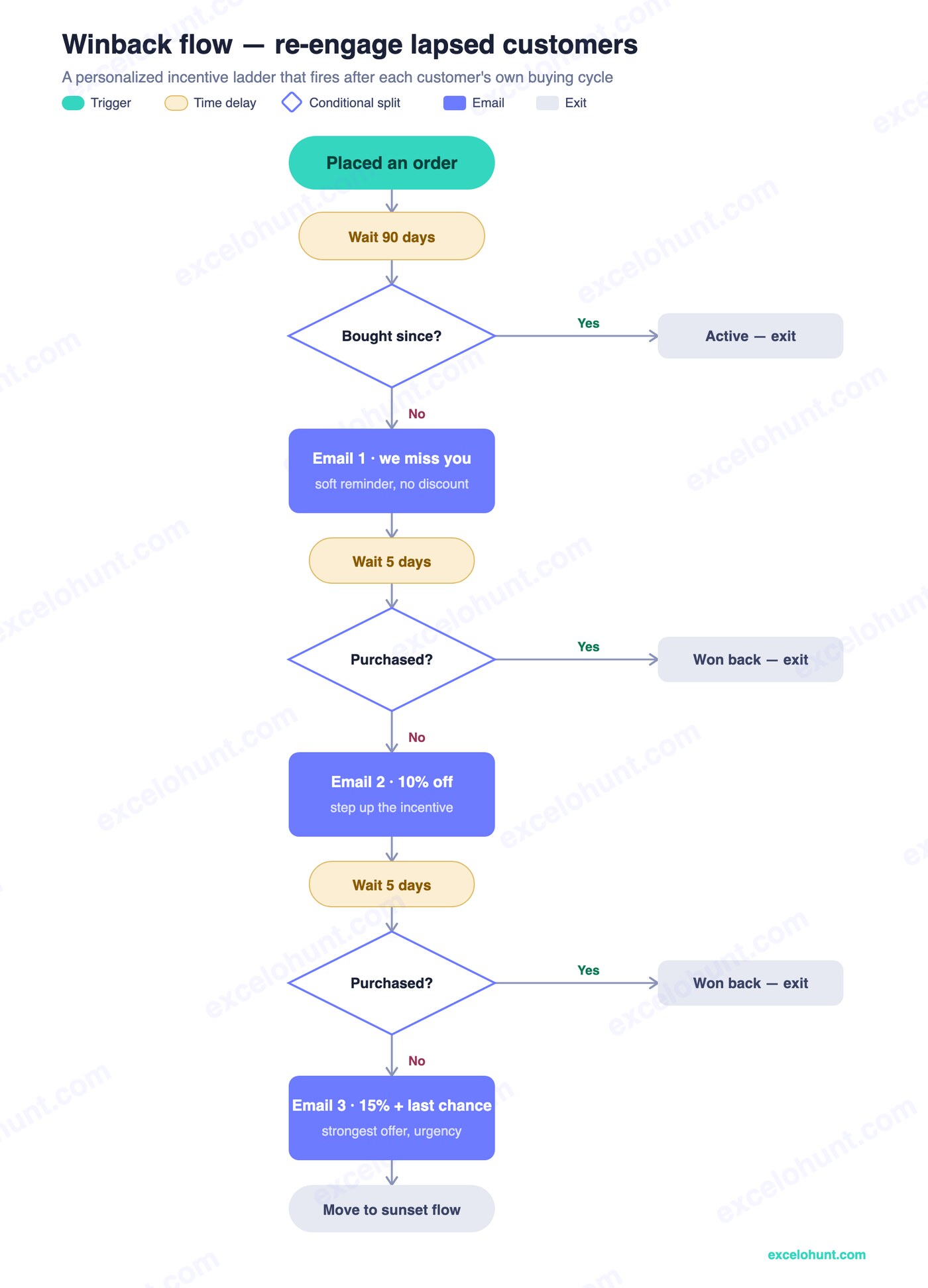
- Email 1 — “We miss you”: no discount. Remind them why they liked you; show what’s new or bestselling.
- Email 2 — small offer: a modest incentive (e.g., 10%) for those who didn’t respond.
- Email 3 — strongest offer + urgency: your best winback offer, with a deadline.
Each step checks “purchased?” first, so anyone who’s reactivated exits before the next (more expensive) offer.
Copy and subject lines that re-engage
Winback copy works when it feels personal, not promotional:
- Lead with the relationship, not the deal in the first email — “It’s been a while” beats “20% off” for openers who haven’t churned on purpose.
- Remind them of value: new arrivals, restocks of what they bought, or an improvement since they last shopped.
- Subject lines: specific and a little human — “Still thinking about you” or “Your favorites are back in stock.” Test these; open rate sets the ceiling on reactivation.
When to stop: sunset and deliverability
A winback flow has a hard end. If someone ignores the whole ladder, stop emailing them through winback and move them to your sunset flow — continuing to send to people who never open drags down your sender reputation and hurts every other flow. Defining unengaged by email engagement (not website browsing) is the nuance most stores miss; our Klaviyo deliverability guide covers exactly how to set the sunset threshold.
Measuring reactivation
Judge the winback flow on reactivation rate and revenue per recipient:
- Share of lapsed customers who place an order during the flow
- Revenue per recipient at each ladder step (so you don’t over-discount)
- How many exit early at the no-discount email (your cheapest wins)
If reactivation is low, revisit your “lapsed” definition and the first email’s relevance before reaching for a bigger discount.
Frequently asked questions
How do you define a lapsed customer in Klaviyo?
Relative to your average time between orders — define lapsed as comfortably beyond it (e.g., 90 days for a brand whose customers normally reorder every 45–60 days), not as a one-size number.
When should a winback flow trigger?
Trigger on Placed Order and add a time delay longer than your buying cycle. Because the trigger is each customer’s own purchase, the delay counts from their last order automatically.
What discount should a winback flow offer?
Climb an incentive ladder: start with no discount (“we miss you”), then a small offer, then your strongest offer with urgency — and let anyone who buys exit before the next step. Never lead with your biggest discount.
What happens to customers who don’t respond to the winback flow?
Move them into a sunset flow rather than continuing to email them. Repeatedly sending to people who never engage harms your deliverability and your other flows.
Is a winback flow the same as a reactivation flow?
Yes. Winback flow and Klaviyo reactivation flow are interchangeable names for the same automation — a sequence that re-engages customers who’ve stopped buying. A sunset flow is different: it targets subscribers who’ve stopped opening emails.
About the author
Ravinderpal Singh is the founder of Excelohunt, a Klaviyo-focused email & SMS agency. The winback structure here comes from reactivation flows we’ve built for ecommerce brands.
Want to re-activate your list profitably? Book a free Klaviyo audit and we’ll build your winback and sunset flows.
More in Klaviyo
- 12 Best Klaviyo Agencies in 2026 (Honest Comparison)
- Klaviyo Agency Pricing: What You Should Pay in 2026
- Optimite Alternatives: Klaviyo Email Agencies Compared (2026)
- How to Set Up Klaviyo: Complete Setup Guide (Step-by-Step)
- How to Use Klaviyo: A Beginner's Guide (2026)